Platform guides· Jane Wilson 6 min read
Starting an Online Store in the US: The Legal Checklist (Structure, EIN, Sales Tax Permit, Licenses)
The legal and tax steps for a new US online store in the order most sellers need them: business structure, EIN, sales tax permit, licenses and records. General information, not legal or tax advice.
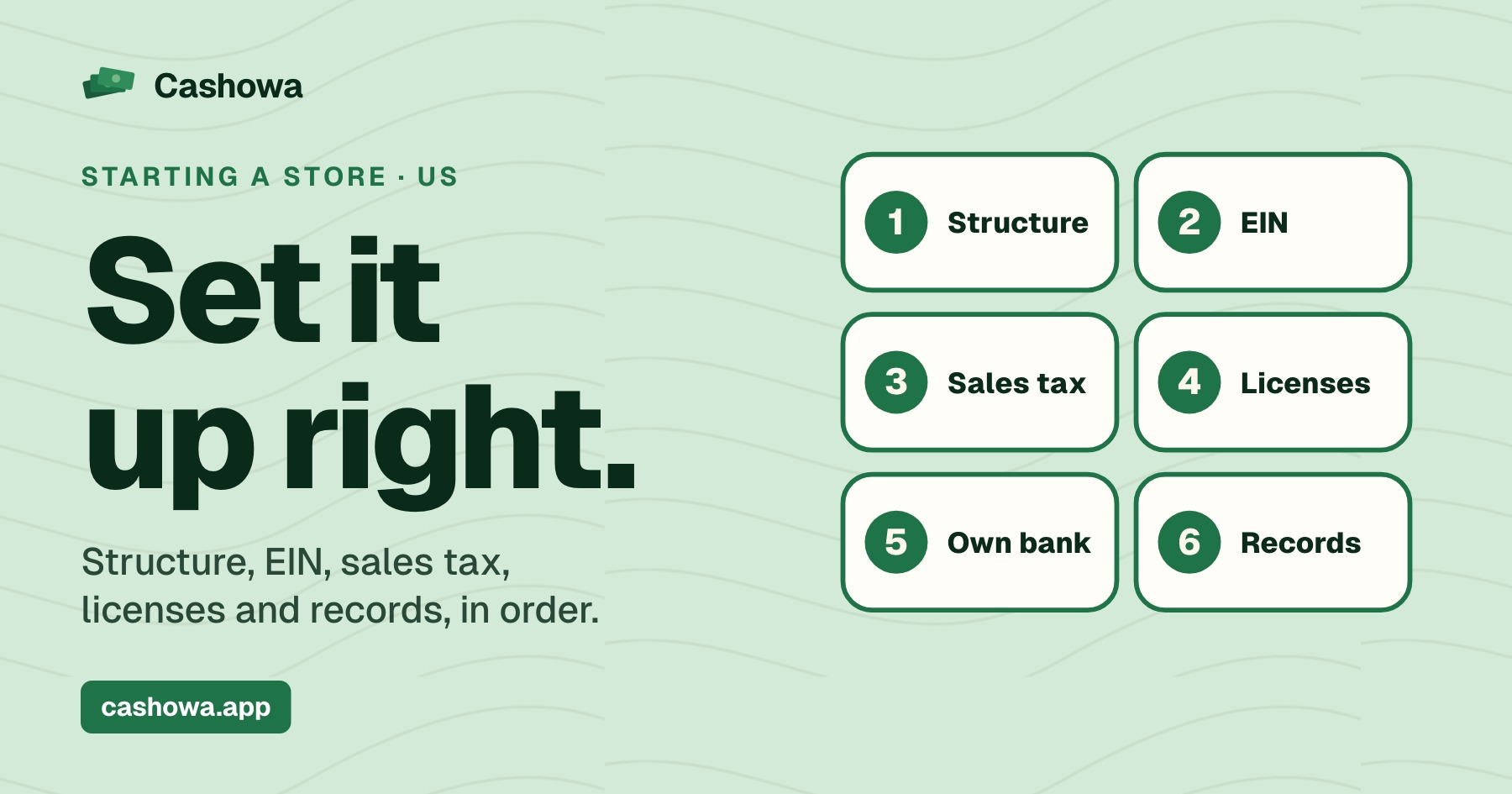
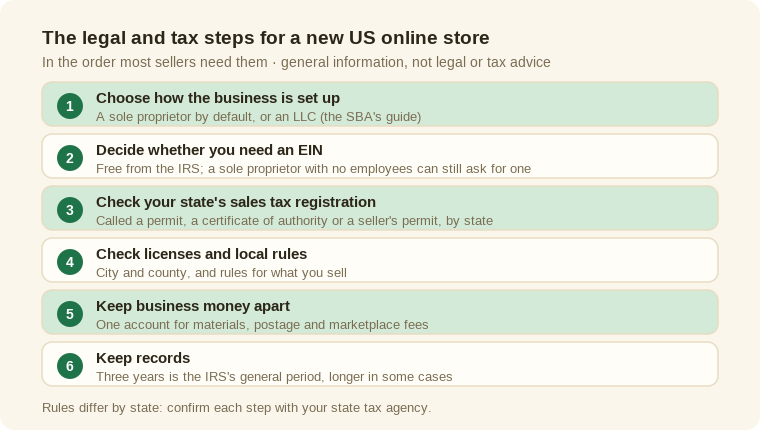
Starting an online store in the US comes with a short list of legal and tax steps, and most of them are simple. This checklist puts them in the order most sellers need them: how the business is set up, whether you need an EIN, whether your state wants a sales tax permit, which licenses to check, which taxes you will meet, and what to keep. It is general information from government pages, not legal or tax advice, and the rules differ by state, so each step says where to confirm yours.
Work out how many sales cover your costs
Try the break-even calculatorStep 1: Choose how the business is set up
The SBA's guide to choosing a business structure says you are automatically a sole proprietor if you do business activities and have not registered as any other kind of business. As a sole proprietor you are personally liable for the business's debts. An LLC is a separate choice: the SBA says "LLCs protect you from personal liability in most instances," that you need a registered agent in your state before you file, and that in most cases the total cost to register is under $300, with fees that vary by state. It also says an LLC's members are self-employed and pay self-employment tax, so forming one changes your liability, not by itself the tax on your profit.
Many sellers start as sole proprietors and form an LLC later, when the liability matters, when they take on a partner or when they begin to hire. A lawyer or accountant can say which fits you.
Step 2: Decide whether you need an EIN
An EIN is the IRS's number for a business. The IRS says you can get one for free directly from the IRS, and warns "Beware of websites that charge for an EIN." Its page on employer ID numbers says you need one if you have employees, and partnerships, LLCs and corporations need one too. A sole proprietor with no employees is not on the list of those who need one, and the page says you can still request one "for banking or state tax purposes."
Step 3: Check your state's sales tax registration
Many states ask sellers of taxable goods to register, and the name of the registration differs. Texas calls it a Sales Tax Permit and says to apply if you are engaged in business in Texas and sell or lease tangible personal property or taxable services; it adds "Allow 2-3 weeks to receive your permit." New York's page on registering as a sales tax vendor says every person who sells taxable tangible personal property or services must register, including home-based sellers and once-a-year sellers, and that you register before beginning business, with a Certificate of Authority. California's tax agency calls it a seller's permit.
The pages we read do not say what a seller must do when every sale goes through a marketplace that collects the tax. That is a question for your state's tax agency. Our guide to sales tax for online sellers in the US covers what Etsy and eBay say they collect.
Step 4: Check licenses and local rules
Beyond sales tax, check whether your city or county asks for a general business license, and whether anything you sell has rules of its own. Food, cosmetics and children's products are examples of regulated goods, and they sit outside this checklist. The SBA keeps a guide to licenses and permits as a starting point.
Step 5: Know the taxes you will meet
The SBA's page on paying taxes lists federal income and employer taxes, and state and local taxes. A seller will also meet self-employment tax, which the IRS gives as 15.3% of net earnings from self-employment, applying when those earnings are $400 or more. And the IRS says sole proprietors generally have to make estimated tax payments if they expect to owe $1,000 or more when they file. Our guide to estimated quarterly taxes for Etsy and eBay sellers gives the 2026 dates.
Step 6: Keep business and personal money apart
A sole proprietor is not asked to open a separate account by any page we read, but many sellers do, because every statement then becomes a business record. Keep the card and the bank account that you use for materials, postage and marketplace fees in one place, and the rest elsewhere.
Step 7: Keep records
The IRS page on recordkeeping says records support the items you report on your tax returns, and its page on how long to keep them gives three years as the general period. Our bookkeeping routine for online sellers and the year-end checklist show what to save and when.
The checklist for starting an online store, in one place
- Choose sole proprietor or LLC.
- Decide on an EIN (free from the IRS).
- Check your state's sales tax registration, and its name.
- Check city and county licenses, and any rules for what you sell.
- Open a separate account for business money.
- Save every statement, receipt and payout report.
- Put the estimated tax dates in your calendar.
Where Cashowa fits
Cashowa starts where this checklist ends, once a store exists. It does not register a business, collect or file sales tax, or give legal or tax advice. What it does for a new store is check every active listing for what is holding it back and, with New listings, draft a listing from your photos and notes for you to approve, without guessing the facts only you can state. How Cashowa works for sellers says what it reads and keeps.
Frequently asked questions
Do I need an LLC to sell on Etsy or eBay?
The SBA says you are automatically a sole proprietor if you do business without registering another kind of business, and that an LLC protects you from personal liability in most instances. Whether a marketplace asks for a particular structure is in that marketplace's own seller terms.
Is an EIN free?
Yes. The IRS says you can get an EIN for free directly from the IRS, and warns against websites that charge for one.
Do I need a sales tax permit if I only sell on Etsy?
It depends on your state and on how it treats marketplace sales. The state pages we read (Texas, New York and California) did not address marketplaces, so ask your state's tax agency. Our sales tax guide covers what Etsy and eBay say they collect.
How early should I register for a sales tax permit?
Texas says to allow 2 to 3 weeks to receive the permit, and New York says to register before beginning business. Other states differ, so check yours before your first sale.
The term 'Etsy' is a trademark of Etsy, Inc. This Application uses Etsy's API, but is not endorsed or certified by Etsy. eBay is a trademark of its owner. Cashowa is independent and is not endorsed or certified by it.