Numbers for sellers· Kamal F 7 min read
A Year-End Checklist for Online Sellers (US): Inventory, Records, 1099-K and the January Tax Date
What to count, export and decide before the year turns: inventory, payouts, the 1099-K, records, a tax set-aside and a last pass over your listings.
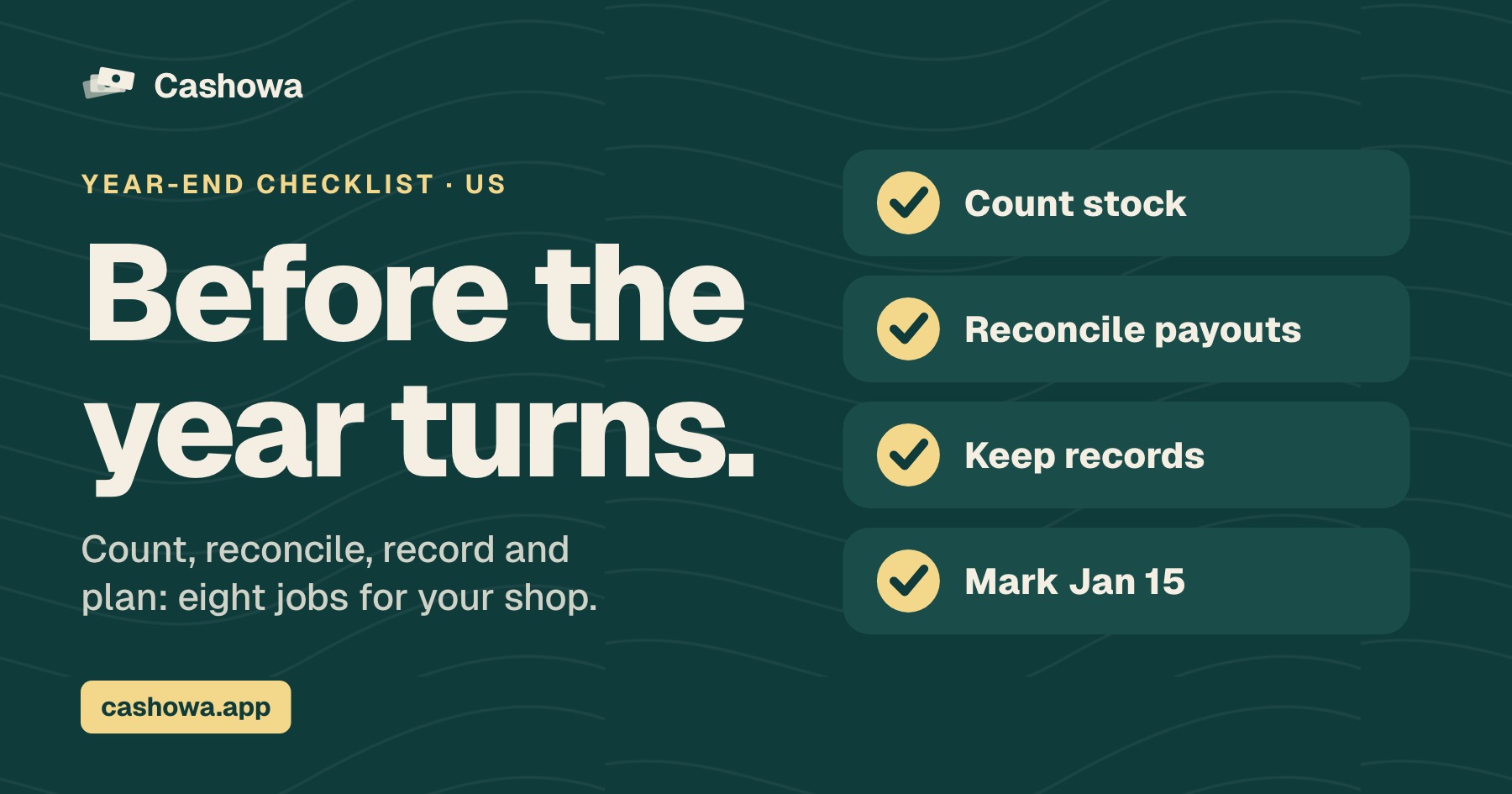
A year-end checklist for an online seller is the short list of things to count, export and decide before the calendar turns: what inventory you are holding, what each marketplace paid you and charged you, which records to keep, what tax to set aside, and which listings need attention in the new year. This one is written for sellers in the United States and uses the IRS's own pages. It is general information, not tax advice, and a tax professional can tell you how it applies to your return.
Run a health check on every listing before January
How Cashowa works for sellers1. Count your inventory
The Schedule C layout for cost of goods sold starts with inventory at the beginning of the year (line 35) and ends with inventory at the end of the year (line 41). IRS Publication 334 says to add lines 35 through 39 and subtract line 41 to reach cost of goods sold on line 42. That is why a count on or near December 31 matters: it sets the closing figure.
Count finished goods, and the materials and supplies you hold to make them. Write down what each item cost you, not what you hope to sell it for. The Schedule C instructions say inventory can be valued at cost, at the lower of cost or market, or by another method the IRS approves, and Publication 334 says your method has to be consistent from year to year. Keep the count sheet with your records. Our guide to cost of goods sold for handmade products walks through the lines with an example.
2. Reconcile what the marketplaces paid you
A payout is not your sales total: fees, refunds and timing sit between them. The IRS page on Form 1099-K describes the form as a report of payments you received for goods or services. It says payment apps and online marketplaces report when payments exceed $20,000 in more than 200 transactions, that card processors issue the form no matter how many payments you got, and that you must still report any income whether or not you receive one.
So for each marketplace, download the year's sales and fee reports and compare the totals with your own sheet. A sale made on December 30 and paid in January is the usual reason the two differ by a few hundred dollars; a bigger gap is worth a closer look. Our guide to Form 1099-K for Etsy and eBay sellers explains what the form counts.
3. Keep your records
The IRS page on recordkeeping says records help you support the items on your tax returns, and that the type of records you need depends on the business you are in. Its page on how long to keep records gives three years as the general period, longer in some cases (six years if you omit income that is more than 25% of the gross income on the return, for example), and says to keep copies of the returns you file.
For a seller that means the marketplace reports you downloaded in step 2, bank and card statements, receipts for materials and postage, your inventory count, and the confirmation of every tax payment you make.
4. Mark the January tax date
IRS Publication 505 lists January 15, 2027 as the payment date for the last part of tax year 2026, and says you can skip that payment if you file your 2026 return by January 31, 2027 and pay the whole balance due. Either way, the money has to exist in January. Our guide to estimated quarterly taxes for Etsy and eBay sellers covers who has to pay and one way to set an amount aside.
5. Check when December's money arrives
Sales in the last weeks of the year do not reach your bank on the day of the sale. How long they take depends on the marketplace and on how long you have sold there. Our guide to when Etsy pays you shows the timeline from Etsy's own pages, and it is worth drawing the same timeline for every channel you use before you plan January's spending.
6. Look at the year in numbers
Before you plan the next year, write down four figures for each month: what customers paid, what the marketplaces and the payment processors took, what your products and postage cost you, and what was left. The pattern tells you which months carry the shop and which months you need cash to cross. If your shop is seasonal, our guide to forecasting cash for a seasonal shop turns last year into a twelve-month plan, and break-even for an online store says how many sales a month cover your costs.
7. Review your listings before the new year
A year of small edits leaves gaps. Go through every active listing for the problems a shopper or a marketplace would notice: a missing or very short title, a thin description, photos with no alt text, a missing price, an item that is out of stock but still live, and a listing nobody has touched in a year. Our guide to the listing health check lists the checks, and the guide to refreshing an old listing says what to update and what to leave alone. Change a few listings at a time, so you can tell afterwards what made a difference.
8. Write down the dates: your year-end checklist
| What | By when |
|---|---|
| Count and value inventory | December 31 |
| Download marketplace sales and fee reports | As soon as the year closes |
| Fourth estimated tax payment, or file and pay in full | January 15 for the payment, January 31 for the return (2027) |
| Listing review and refresh | January |
Where Cashowa fits
Cashowa does not value inventory, reconcile a 1099-K or file tax. It can take two of these steps off your hands. Its listing health check runs counted checks on every active listing (missing or short titles, thin descriptions, no photos, no alt text, no price, out of stock but still live, not changed in a year) and shows the counts worst first; the thresholds, such as a year without a change, are Cashowa's own rules of thumb, not a marketplace's. Its Did it work? page compares your sales in the 14 days before and after a change, using the sales reports you upload, and says when there are too few sales to tell. And the Cash flow page shows revenue, costs and net margin over time from the statements you upload. How Cashowa works for sellers says what it reads and keeps.
Frequently asked questions
What should be on a year-end checklist for an online seller?
Count and value your inventory, reconcile each marketplace's payouts with your own records, keep the records the IRS says support your return, plan for the January estimated tax date, look at the year's numbers, and review your listings.
How long should I keep my records?
The IRS gives three years as the general period and lists longer ones for some situations, such as six years if you omit income that is more than 25% of the gross income shown on the return. It also says to keep copies of the returns you file.
Why does my 1099-K not match my sales?
The form reports payments received, and your sales total is a different number: fees, refunds and the timing of payouts sit between them. Compare the form with your own marketplace reports, and remember that you must report your income whether or not you receive a form.
Do I have to make the January 15 estimated payment?
Publication 505 says you can skip it if you file your 2026 return by January 31, 2027 and pay the entire balance due with it. Otherwise it is the last of the four dates.
The term 'Etsy' is a trademark of Etsy, Inc. This Application uses Etsy's API, but is not endorsed or certified by Etsy. eBay is a trademark of its owner. Cashowa is independent and is not endorsed or certified by it.