Numbers for sellers· Kamal F 5 min read
Break-Even Point for an Online Store: How Many Sales Cover Your Costs
How to work out the break-even point for an online store, with a worked example that includes marketplace fees, and what moves the number.
The break-even point of an online store is the number of sales a month at which what you keep from sales equals your fixed costs, so you neither make nor lose money. Everything below it is a loss and everything above it is profit. It takes four numbers and two lines of arithmetic. This guide shows the sum with marketplace fees in it, works one example through, and shows what moves the answer.
Work out your own break-even point
Open the break-even calculatorThe four numbers
- The price of one sale. What the buyer pays for an order, shipping included if you charge it.
- The fees that scale with the price. For an Etsy order, the 6.5% transaction fee and the 3% payment processing fee are percentages of the order, so together they are 9.5%. How to price a product and what Etsy actually takes from a sale cover the stack.
- The cost of one sale. What it costs you to make and deliver it, including flat per-sale charges: materials, packaging, the shipping label, and flat fees such as the $0.25 payment charge.
- Your fixed costs for a month. What you pay whether or not anything sells: rent, software, insurance, and your own pay if you want it covered.
The two lines of arithmetic
What you keep from one sale is the price, less the percentage fees, less the cost of the sale. The break-even point is your fixed costs divided by that. In the terms of contribution margin, it is how many times a sale's contribution you need to cover what is fixed.
- What you keep per sale = price × (1 − fee percentage) − cost of the sale
- Break-even sales a month = fixed costs ÷ what you keep per sale
A worked example of the break-even point
This is an invented shop, worked with the break-even calculator's own formulas. An order is $40: a $35 item and $5 shipping. The fees that scale with the price are 9.5%, which is $3.80. The cost of the sale is $16.45: $9.00 of materials, $1.50 of packaging, $5.50 for the shipping label, and $0.45 of flat fees (the $0.25 payment charge and a $0.20 listing fee). Fixed costs are $600 a month: studio rent, software and insurance.
- What it keeps per sale: $40 less $3.80 of fees less $16.45 of cost leaves $19.75, which is 49.4% of the order.
- Break-even sales: $600 ÷ $19.75 is 30.4, so 31 sales a month, which is $1,240 in orders.
- A profit goal of $1,000 a month: ($600 + $1,000) ÷ $19.75 is 81.01, so 82 whole sales are needed.
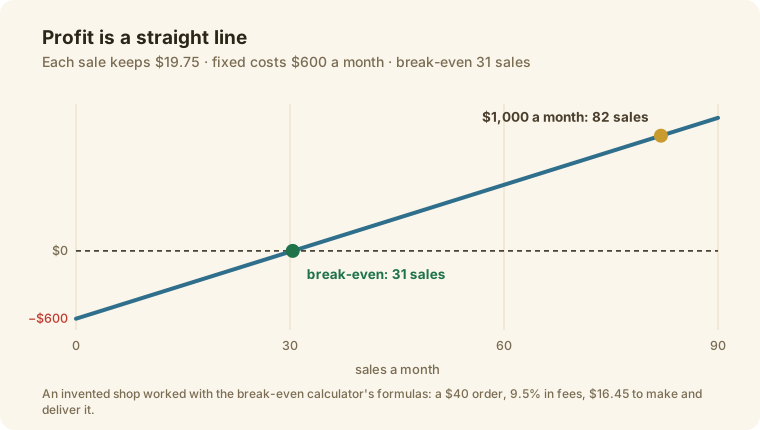
Profit is a straight line: it starts at minus $600 with no sales and rises $19.75 with each one. At 30 sales it is still a loss of $7.50, and at 31 it is $12.25 of profit.
What moves the number
The calculator tests four changes against the same example:
| Change | Break-even sales | Fewer sales than before |
|---|---|---|
| Raise the price 5% | 28 | 3 |
| Raise the price 10% | 26 | 5 |
| Cut the cost of each sale 10% | 29 | 2 |
| Cut fixed costs 10% | 28 | 3 |
A price rise lowers the number most here, because each sale keeps more even after the fee percentage on the higher price. The calculator shows what each change does to the sums. Whether a price rise changes how many orders you get is something you learn by trying a small one and watching the next few weeks.
What counts as a fixed cost, and what does not
A cost is fixed if you pay it whether or not you sell: rent, software subscriptions, insurance, a retainer. A cost is part of the sale if it only exists because you sold: materials, packaging, the label, the payment fee. Putting a variable cost in the fixed column makes the break-even point look easier than it is, and the reverse makes it look harder. When you are unsure, ask whether the cost goes away in a month with no orders.
Mistakes worth checking for
- Leaving out your own pay. If you want the shop to cover it, put it in fixed costs.
- Using the item price and forgetting shipping you charge. The fees apply to the whole order.
- Treating flat fees as percentages. A $0.25 charge belongs in the cost of the sale.
- Using last year's fees. Platforms change them, so check the current page.
- Rounding down. You cannot make 30.4 sales, so 31 is the number.
Where Cashowa fits
The break-even calculator on this site is free, and it runs the sum above with your own price, fee percentage, cost per sale, fixed costs and profit goal, then shows the levers. For the numbers behind it, Cash flow sorts your uploaded statements into categories, so you can see your actual fixed costs and fees by month, and the Forecast page lets you name a monthly or one-off change, such as a second kiln, and see its effect on your cash. What Cashowa can do shows each screen.
Frequently asked questions
What is the break-even point of an online store?
The number of sales a month at which what you keep from sales equals your fixed costs. It is your fixed costs divided by what you keep from one sale.
How do I include marketplace fees in the break-even point?
Take the fees that scale with the price as a percentage, such as Etsy's 6.5% and 3%, and the flat ones as part of the cost of the sale, such as a $0.25 payment charge. The sum above does both.
How many sales do I need to make a profit?
Break-even plus however many sales cover the profit you want. In the example above, 31 sales break even and 82 sales make $1,000 a month.
What is the quickest way to lower my break-even point?
In the example, a 10% price rise lowers it by 5 sales, and cutting fixed costs 10% or the cost of each sale 10% each lower it by 3 and 2. The right lever for you depends on which number is easiest for you to move.
The term 'Etsy' is a trademark of Etsy, Inc. This Application uses Etsy's API, but is not endorsed or certified by Etsy.