Business· Kamal F 6 min read
Etsy Fees in 2026: What Etsy Actually Takes From a £30 Sale
Etsy publishes every fee it charges, and almost no seller can tell you their own effective rate. Here is the whole stack against one real order — including the two lines nobody mentions.
Etsy fees are not hard to find. Every one of them is published, in plain English, on Etsy's own help pages. And yet if you ask a shop owner what percentage of their revenue Etsy actually keeps, you will almost always get the same answer: "six and a half percent, I think?"
That answer is wrong by a factor of two for most sellers, and by a factor of five for some. Not because anybody is lying, but because the fees are quoted against four different bases, and a number quoted against a base you are not thinking about is a number you cannot add up in your head.
Work out your own effective rate in about ten seconds
Open the free Etsy fee calculatorSo here is the whole stack, against one order, with nothing left out.
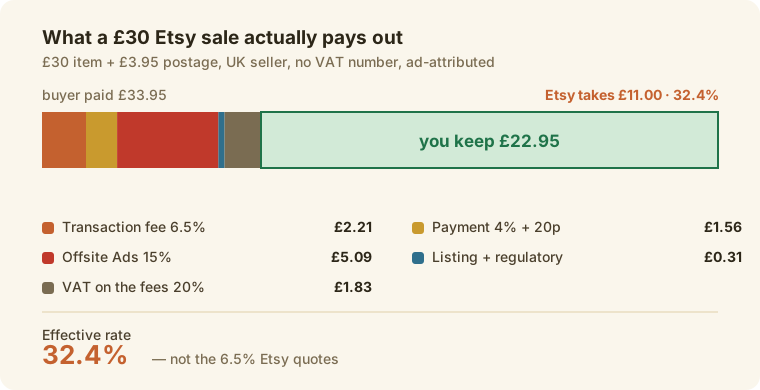
The order we are using
A £30 item, £3.95 postage, sold by a UK shop that has not given Etsy a VAT number, where the buyer arrived through an Etsy advert. The buyer pays £33.95.
That last condition matters enormously, and we will come back to it. But first, the fees that apply to every sale.
Every rate below is published by Etsy in its Fees & Payments Policy — the arithmetic is what is missing, not the numbers.
Listing fee — £0.20. Charged when you list, and again every four months if the listing auto-renews. It is the smallest fee in the stack and the one people think about most, because it is the only one you pay before you have sold anything.
Transaction fee — £2.21. This is the famous 6.5%, and the detail worth knowing is what it is charged on: the item price plus the postage. If you charge £3.95 to post something, Etsy takes its cut of that £3.95 too, even though the money goes straight to a courier. Gift wrap counts as well.
Payment processing — £1.56. A percentage plus a fixed amount, both set by the country your shop is registered in: 4% + £0.20 in the UK, 3% + $0.25 in the US, 4% + €0.30 across much of the EU. The fixed part is why small orders are so much worse than they look — 20p on a £3 sticker is 6.7% before anything else has been counted.
Regulatory operating fee — £0.11. Charged in the UK, France, Italy, Spain and Turkey, where governments levy a digital services tax that Etsy passes on. It is a fraction of a percent, it appears on your statement without explanation, and it is in none of the popular calculators.
That is £4.08 so far — about 12% of what the buyer paid. Which is roughly the number most sellers have in their head, and it is where most articles about Etsy fees stop.
The two Etsy fees that change the answer
Offsite Ads — £5.09. Etsy advertises your listings on Google, Meta and elsewhere. If a buyer clicks one of those adverts and then buys from you within 30 days, Etsy charges 15% of the entire order.
Read that again: not 15% of the advertising cost, and not 15% of the profit. Fifteen percent of the whole order, on a sale you may well have made anyway.
Under $10,000 of sales in a rolling twelve months you can switch this off. Cross that threshold once and you are enrolled permanently, at a reduced 12%, with no opt-out. Etsy caps the fee at £100 per order, which tells you something about the size of order this was designed for.
VAT on the fees — £1.83. This is the one almost nobody accounts for, and it is pure arithmetic. If you are a UK or EU seller and you have not given Etsy a VAT number, Etsy charges VAT on its own fees. Not on your sale — on the fees. At 20%, that turns a headline 6.5% transaction fee into 7.8%, and it applies to every line above.
So what does Etsy actually take?
£11.00 of £33.95. An effective rate of 32.4%.
The seller keeps £22.95. If their materials and postage cost £12, they have made £10.95 on a £30 product — and if they priced it by adding a comfortable-sounding margin to their costs, they may well have made less than nothing.
Take Offsite Ads out of the picture and the same order costs £4.89, or 14.4%. That is the honest range for a UK Etsy seller: somewhere between 14% and 33%, depending on how the buyer found you — which is not something you control, and not something you can see until the statement arrives.
What to do with this number
Three things follow, and none of them are "leave Etsy".
Stop thinking in percentages and start thinking in pounds per order. The fixed components mean your effective rate falls as order value rises. A £3 sticker and a £60 cushion are completely different businesses on the same platform.
Price backwards. Decide what you need to keep, then solve for the price that leaves you that after fees. Adding a margin forwards does not work, because the percentage fees apply to the new price too — the gap compounds against you. Our piece on how to price a product when you don't know your real costs walks through the arithmetic.
Register for VAT if the maths works. Giving Etsy a VAT number removes that final £1.83 line entirely. Whether that is right for you depends on far more than Etsy fees, but most sellers do not realise it is even a factor.
Etsy's own guide to fees and taxes for sellers is worth reading once in full, particularly the VAT section.
And if you are approaching $10,000 in annual sales, work out what Offsite Ads will cost you before you cross the line rather than after. It is the one fee in this stack that changes permanently, and the only one you get no second chance on.
Frequently asked questions
How much does Etsy actually take per sale?
For a UK seller with no VAT number, between 14% and 33% of what the buyer paid. The lower figure is an organic sale; the higher one is a sale attributed to Offsite Ads. On a £30 item with £3.95 postage that is £4.89 at the low end and £11.00 at the high end.
Why are my Etsy fees higher than 6.5%?
Because 6.5% is only the transaction fee. On top of it sit payment processing (a percentage plus a fixed amount per order), the listing fee, a regulatory operating fee in some countries, Offsite Ads if the sale came through one, and — for UK and EU sellers without a VAT number — VAT charged on all of those fees.
Is the Etsy Offsite Ads fee really mandatory?
Above $10,000 in sales over a rolling twelve months, yes. Below it you can opt out. Once you cross the threshold you are enrolled permanently at 12% instead of 15%, and you cannot opt out again. The fee is capped at £100 per order.
Does Etsy charge fees on postage?
Yes. The transaction fee, the payment processing fee, the regulatory operating fee and Offsite Ads are all calculated on the item price plus the postage you charged. This is why "free postage" is never free — you absorb the cost and still pay fees on the amount you built into the price.
Do Etsy sellers pay VAT on Etsy's fees?
UK and EU sellers who have not supplied Etsy with a VAT number do, at their local rate. At 20% it adds about a fifth to the entire fee stack. Supplying a valid VAT number removes it.