Business· Thomas Cuccittini 6 min read
Etsy vs eBay vs Amazon: Which One Actually Leaves You the Most?
Etsy is the cheapest on a normal sale and the most expensive the moment an ad is involved. Here is the same $30 product on all three, with every fee counted.
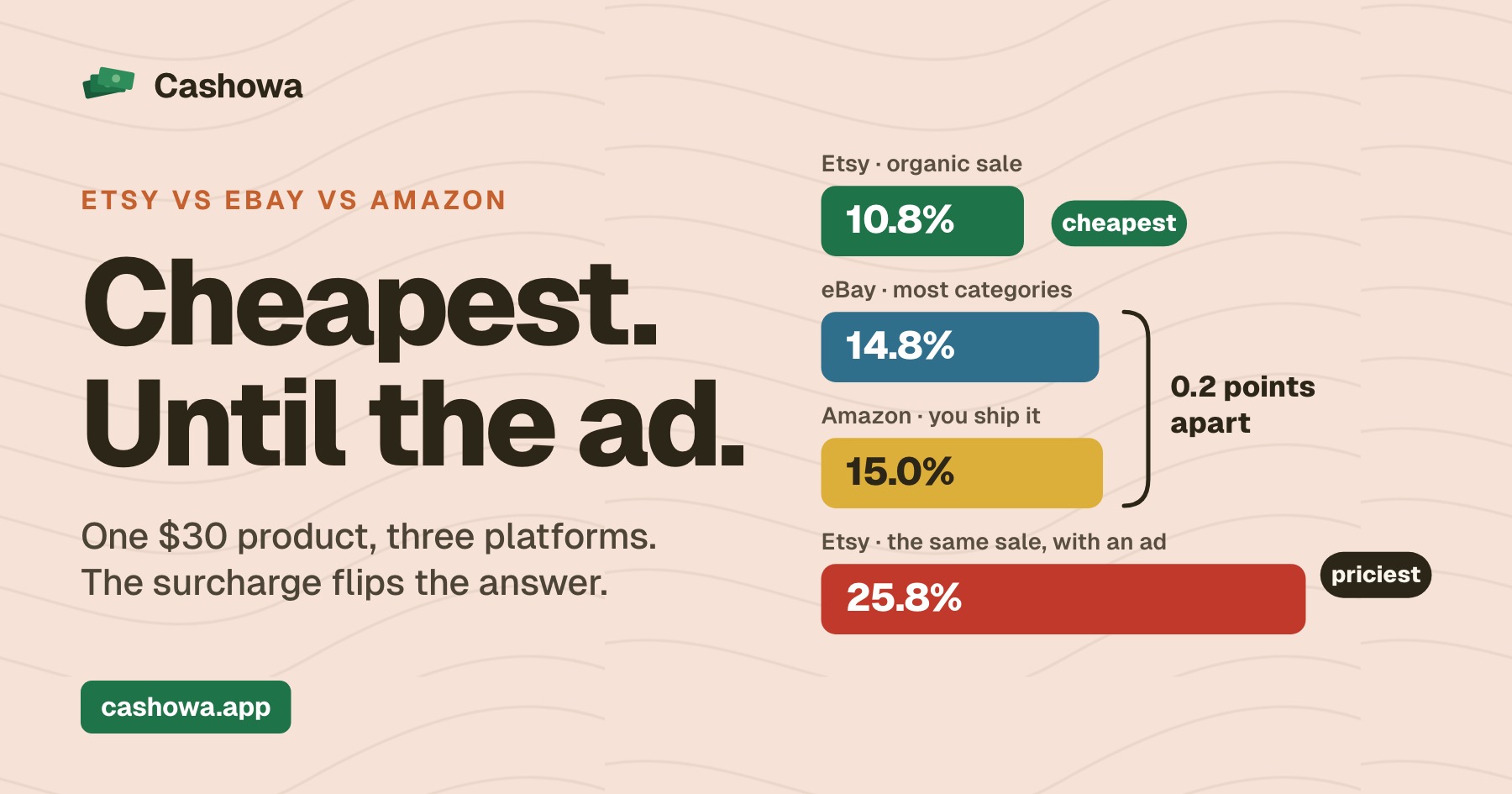
Etsy vs eBay vs Amazon is usually argued on headline percentages, which is why the arguments never resolve. Etsy says 6.5%. Amazon says 15%. eBay says it depends on the category. None of those numbers is what you actually pay, and comparing them tells you nothing.
So here is the same product on all three, with every fee included and the category stated. The answer is less simple than "which is cheapest", and more useful.
Run your own product through the fee stack
Open the free fee calculatorThe product, and the scenarios
A $30 item with $3.95 shipping — the buyer pays $33.95 — sold by a US seller, with sales tax left out so the three are comparable.
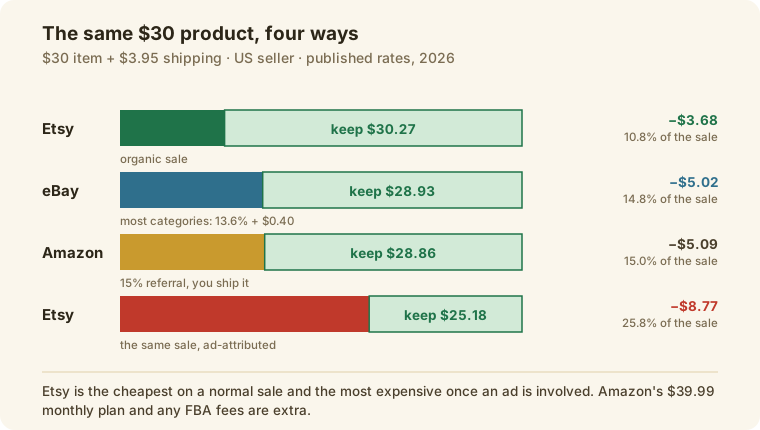
Etsy, organic sale: $3.68 (10.8%). The $0.20 listing fee, the 6.5% transaction fee and payment processing at 3% + $0.25. On a normal sale, this is the cheapest of the three.
eBay: $5.02 (14.8%). A final value fee of 13.6% of the total sale — eBay publishes it for most categories, on sales up to $7,500 — plus $0.40 per order over $10. Rates vary by category, and eBay charges its percentage on shipping and on sales tax too — Etsy does not apply its transaction fee to sales tax for US sellers.
Amazon, shipped by you: $5.09 (15.0%). A 15% referral fee, which is the rate for most categories — some are lower, and clothing runs 5%, 10% or 17% depending on the price. This excludes the $39.99 monthly Professional plan and any FBA fulfillment.
Etsy vs eBay vs Amazon: who is actually cheapest?
On a normal sale, Etsy is the cheapest: 10.8%, against 14.8% for eBay and 15.0% for Amazon. eBay and Amazon sit a fifth of a point apart, which is as close to identical as two different fee structures get.
And then there is the red bar. The same Etsy sale, if Etsy attributes it to one of its own ads, costs $8.77 — 25.8%. That makes Etsy the most expensive of the three by almost eleven points. It is not a different platform, it is the same platform on a different Tuesday.
That is the real finding, and it is the opposite of the headline-percentage argument: the platform with the lowest base fee and the platform with the highest all-in cost are the same platform, and which one you get is decided by how the buyer arrived.
The surcharges are the real comparison
Etsy: Offsite Ads. 15% of the whole order when Etsy attributes the sale to one of its ads. Below $10,000 of annual sales you can opt out. Cross that threshold once and you are enrolled permanently at 12%, with no opt-out. This is the single largest swing factor in the whole comparison, and you do not control it.
Amazon: the monthly plan and FBA. $39.99 a month before you sell anything, which is 2.5% of a $1,600 month and 24% of a $165 month. The Individual plan charges $0.99 per item instead, which suits very low volume. And if you use FBA, fulfillment is charged by size and weight tier — frequently larger than the referral fee itself for anything bulky or light. An Amazon comparison that ignores FBA tiers is not a comparison.
eBay: listing volume. You get 250 zero-insertion-fee listings a month, then $0.35 each. Small for most sellers, large for anyone with a deep catalog.
All three: shipping. Every platform here charges its percentage on the shipping you collected, not just the item. "Free shipping" means you absorbed the cost and are still paying a fee on the portion you built into the price.
How to actually choose
Fees matter here, but they are not the main criterion. A four-point gap between Etsy's organic rate and the others is real money, and it is still smaller than the gap between having buyers and not having them. Three better questions:
Where does the demand already exist? Etsy buyers are shopping for handmade, vintage and personalized. Amazon buyers are shopping for a specification. eBay buyers are shopping for a price. A few points of fee is noise against being on the platform where people are already looking for your thing.
How much of the traffic will you have to buy? This is where Etsy's Offsite Ads and Amazon's advertising change the arithmetic entirely. A platform with a 10.8% fee where some of your sales arrive through an ad is not a 10.8% platform.
What is your order value? Fixed components — $0.40 per order on eBay, $0.20 listings and $0.25 payment fees on Etsy, the $39.99 Amazon plan — hurt small orders disproportionately. At a $5 order the fixed fees dominate and the percentages barely matter. At $150 they vanish.
The check worth doing
Fees change, they differ by category, and the figures here are published rates for one scenario rather than a promise about yours. Run your own product, with your own category rate and your own shipping, before you move anything. Our free Etsy fee calculator does the Etsy side — pick your country first — and will solve backwards for the price you need to hit a target take-home.
Then do the same arithmetic by hand for whichever other platform you are weighing. It takes ten minutes and it is the only version of this comparison that applies to you.
Frequently asked questions
Which is cheaper, Etsy, eBay or Amazon?
On a normal $30 sale with $3.95 shipping, Etsy is cheapest at about 10.8%, then eBay at 14.8% and Amazon at 15.0%. But a sale Etsy attributes to its Offsite Ads costs 25.8%, which makes it the most expensive of the three.
How much does eBay take from a sale in the US?
For most categories, 13.6% of the total sale — including shipping and sales tax — on sales up to $7,500, plus $0.40 per order over $10. Rates vary by category, and you get 250 zero-insertion-fee listings a month before the $0.35 listing fee applies.
Why is Amazon's 15% referral fee not the whole cost?
Because the Professional selling plan is $39.99 a month before any sale, and FBA fulfillment is charged by product size and weight tier. For light or bulky items the fulfillment fee can exceed the referral fee.
Do all marketplaces charge fees on shipping?
Etsy, eBay and Amazon all calculate their percentage on the total the buyer paid, including shipping. Offering free shipping does not avoid this — you absorb the shipping cost and still pay a fee on the part you built into the item price.
Which marketplace should I sell on?
Not simply the one with the lowest fee. Choose on where demand for your specific product already exists, how much of your traffic you will have to pay for, and whether your average order value is high enough to absorb the fixed per-order fees.