Fees & profit· Thomas Cuccittini 6 min read
How to Price a Product When You Don't Know Your Real Costs
Cost plus a comfortable margin is how most people price, and it is why so many sellers work hard for a loss they cannot find. The fix is to solve the problem backwards.
Almost everyone learns how to price a product the same way: add up what it cost you, add a margin that feels reasonable, and that is your price. It is intuitive, it takes ten seconds, and for anyone selling through a marketplace or taking card payments it is quietly wrong.
Not wrong by a rounding error. Wrong in the direction that turns a sale into a loss while your spreadsheet says you made 25%.
Find the price that leaves you what you need
Open the free Etsy fee calculatorWhy adding a margin forwards does not work
Here is the arithmetic that catches people. Your product costs $12 to make and ship. You add 25%, so you charge $15.
Then the fees arrive. On Etsy, for a US seller, on a sale the platform attributed to its own advertising, you keep $10.88 of that $15.
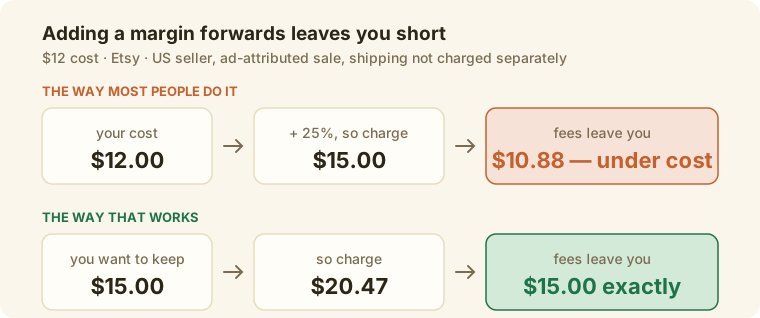
Your cost was $12. You have lost $1.12 on a sale you priced for a profit, and nothing in your pricing process would ever have told you.
And you do not get to choose which kind of sale you get. The same $15 on a sale that did not come through an ad would have left $13.13 — a $1.13 profit. Same product, same price, opposite result, decided by how the buyer happened to arrive.
The reason is that the percentage fees apply to the price you are solving for. Raise the price to cover them and you raise them too. You cannot add your way out of a proportional cost — which is why "just add 25%" and "just add the fee percentage" both leave you short, and why the gap grows with the price rather than staying constant.
How to price a product by working backwards
Decide what you need to keep. Then find the price that leaves you exactly that after fees.
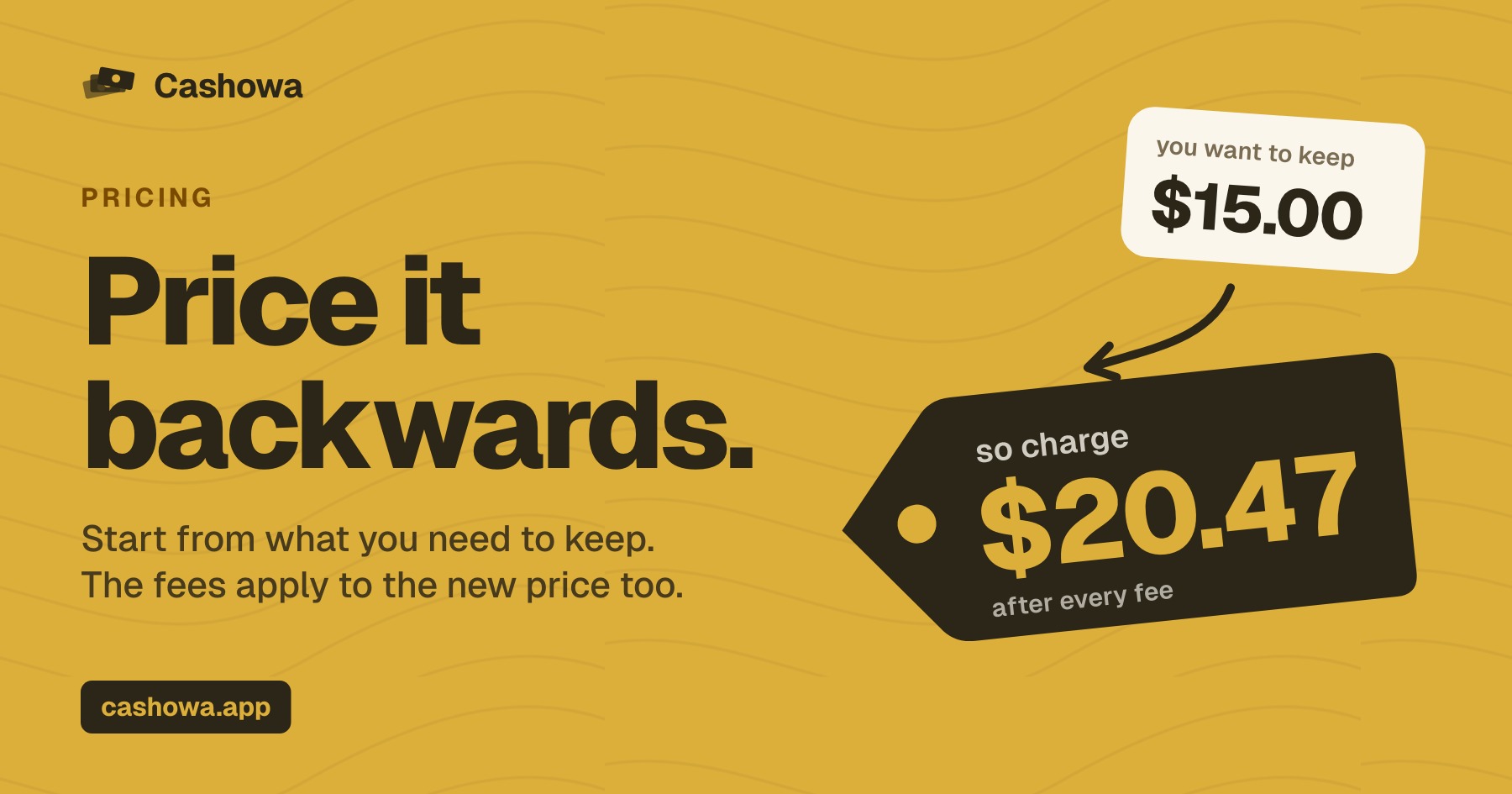
To keep $15 on that same Etsy sale, you need to charge $20.47. That is not a 25% markup on cost. It is the only price that actually delivers the outcome you wanted, and the difference between $15 and $20.47 is the entire reason that businesses in this position never understand where their money went.
You can do this by hand with a few iterations — guess, compute the take-home, adjust, repeat — or use a calculator that solves it. Our free Etsy fee calculator has it built in: choose your country, enter what you want to keep and it returns the price.
Which costs actually belong in the number
The second reason people cannot price is that they do not know their costs, and the reason they do not know their costs is that the obvious ones are not the expensive ones.
Materials. Usually known, usually right.
Shipping and packaging. Frequently underestimated, because people remember the carrier fee and forget the box, the tape, the tissue, the thank-you card and the label. Weigh and cost a finished parcel once.
Platform fees. The whole stack, not the headline rate — Etsy lists every one of its own in the Fees & Payments Policy. For a US Etsy seller this is 11–26% of the sale, and it moves depending on how the buyer found you.
Payment processing, if you sell anywhere other than a marketplace that bundles it.
Your own time. This is the one that gets left out entirely, and it is usually the largest single cost. If something takes you forty minutes to make and you have decided your time is worth $20 an hour, that is $13.33 — more than the materials in most handmade businesses. Leaving it out does not make it free; it makes your wage the variable that absorbs every mistake.
Returns and breakages. If 3% of orders come back, every order effectively carries 3% of a refund. Price it in once rather than absorbing it as a surprise.
Advertising, if you run any. Divide the monthly spend by the orders it produced.
Then check the number against reality
Two sanity checks, both quick.
Does the margin survive the worst case? Price against your highest fee scenario, not your average. On a $15 item, an ad-attributed sale costs you 27.5% and an organic one 12.5%. Pricing for 12.5% means every ad-attributed sale is a loss — and you do not get to choose which is which.
Does it survive a discount? If you intend to run sales, your full price has to absorb the discount and still clear costs. A 20% discount on a 25% margin leaves 5%, and a 20% discount on a margin calculated forwards leaves nothing.
The uncomfortable part
Working backwards frequently produces a price higher than you expected, and the first instinct is to assume the market will not pay it.
Sometimes that is true, and the honest conclusion is that the product does not work at that cost — which is worth knowing in month two rather than year two. But often the price is fine and the fear is not. Most small sellers under-price, not because they tested the market and found a ceiling, but because they never priced from what they needed in the first place.
The arithmetic will not tell you what your market will bear. It will tell you the floor below which selling more makes things worse, and that floor is the one number you genuinely cannot guess at.
Frequently asked questions
How do I price a product to make a profit after fees?
Work backwards. Decide the amount you need to keep, then solve for the price that leaves you that figure once every fee has been deducted. Adding a margin to your cost does not work, because percentage fees apply to the higher price as well, so the shortfall grows with the price.
What is a good profit margin for a product?
There is no single answer, but the useful test is whether the margin survives your worst-case fee scenario and any discount you intend to run. A margin that only works on organic sales at full price is not a margin — it is a best case.
Should I include my own time in the product cost?
Yes. For most handmade and small-batch products, labor is the largest single input. Leaving it out does not remove the cost, it just means your own pay absorbs every error in the rest of the calculation.
Why do my products sell well but make no money?
Usually because the price was set by adding a margin to materials, while the real costs include platform fees, payment processing, packaging, returns and labor. Volume then multiplies a per-unit loss instead of a per-unit profit.
How do I account for marketplace fees in my pricing?
Treat them as a percentage of the final price, not a fixed cost, and price against the highest rate you could be charged rather than the average. On Etsy that means pricing for an ad-attributed sale, because you cannot choose how a buyer arrives.
The term 'Etsy' is a trademark of Etsy, Inc. This Application uses Etsy's API, but is not endorsed or certified by Etsy.