Numbers for sellers· Jane Wilson 8 min read
Etsy Seller Tax in the UK: The Trading Allowance, HMRC Reporting and Self Assessment
For sellers who live in the UK: the £1,000 trading allowance, when to register for Self Assessment, what Etsy reports to HMRC, and how VAT differs. General information, not tax advice.
Etsy seller tax in the UK comes down to three HMRC rules: the £1,000 trading allowance (about $1,350), which lets small amounts of trading income go unreported; Self Assessment, which you register for once you are over it; and platform reporting, under which Etsy and other marketplaces send information about their sellers to HMRC each year. This guide is general information for sellers who live in the UK, built from GOV.UK's own pages and Etsy's. It is not tax advice, and your own situation may differ, so check the pages linked below or ask an accountant.
Check how close you are to the VAT threshold
Try the VAT threshold calculatorWho this guide is for
Most of Cashowa's readers sell from the United States, and this guide is for the UK sellers among them. Dollar figures are approximate, at about $1.35 to the pound, and the rate moves. If you sell from the United States, the guides to sales tax for online sellers and to Form 1099-K for Etsy and eBay sellers are the ones to read.
Etsy seller tax in the UK: are you trading?
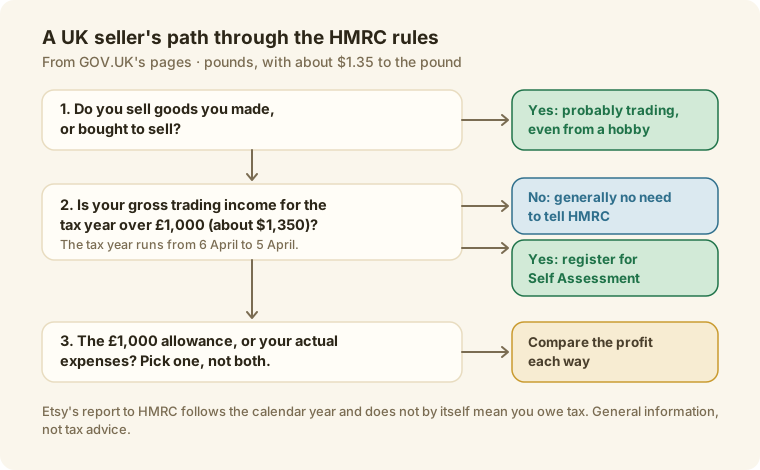
GOV.UK's page on checking whether you need to tell HMRC about income from online platforms, read on November 16, 2026, says you are probably trading if you sell goods that you bought intending to sell for a profit, or goods that you made, including items you make for a hobby. Income from different trading activities is added together. If you sell your own personal possessions you probably do not have to pay Income Tax on them, though an item sold for more than £6,000 (about $8,100) may bring Capital Gains Tax. An Etsy shop that sells what you make is, in HMRC's terms, probably trading, even if it began as a hobby.
The £1,000 trading allowance
GOV.UK's guidance on tax-free allowances on property and trading income describes a tax exemption of up to £1,000 (about $1,350) a year for individuals with trading income. It says that if your gross trading income is £1,000 or less you generally do not need to tell HMRC, with exceptions, for example if you cannot use the allowance. If it is more than £1,000 you must register for Self Assessment, and you then choose between using the allowance and deducting your actual expenses. You cannot do both: the page says you cannot deduct other expenses or allowances if you claim the allowance. It also lists cases where you cannot use the allowance at all, such as trading income from a company you or someone connected to you controls, or from your employer.
Here is an invented example of the choice. A seller has £6,000 (about $8,100) of Etsy sales in the tax year and £4,200 (about $5,670) of costs: materials, Etsy fees, postage and packaging.
| Use the allowance | Deduct actual expenses | |
|---|---|---|
| Sales | £6,000 | £6,000 |
| Taken off | £1,000 (the allowance) | £4,200 (the costs) |
| Profit to tax, before other allowances and rates | £5,000 (about $6,750) | £1,800 (about $2,430) |
The costs are larger than £1,000, so deducting them leaves less to tax. A seller with the same sales and only £300 of costs would be left with £5,700 (about $7,700) by deducting them, so the allowance would be the better choice. The comparison is simple arithmetic, and it is why a record of every cost matters.
Registering for Self Assessment
GOV.UK's page on becoming a sole trader says you must register for Self Assessment as a sole trader if you earn more than £1,000 in a tax year, which runs from 6 April to 5 April. You can start trading before you register, and you can choose to register earlier. The page on Self Assessment deadlines says you must tell HMRC by 5 October if you need to complete a tax return for the previous year, which was 5 October 2026 for the 2025 to 2026 tax year. For that year it gives 31 January 2027 for the online return and for paying the tax, and 31 October 2026 for a paper return. Check the page for the year you are in.
What Etsy reports to HMRC
Etsy's help page on what information Etsy reports for sellers in the EU, UK and Canada says that for the UK it reports to HMRC under the Model Rules for Reporting by Platform Operators. It reports a seller when any one of these applies in a calendar year: 30 or more sales of physical goods, sales of physical goods of 2,000 euros (about £1,700) or more after taxes and fees, or any sales of made-to-order digital items, which are custom files made to a buyer's specification. Instant-download files are not counted. For an individual seller the information includes name, address, date of birth, the bank account that receives the sales funds and tax identifiers, plus totals of transactions, amounts paid per quarter and fees. Reports go in by January 31 each year, and Etsy provides each seller a PDF summary of what it reported.
GOV.UK's page on selling goods or services on a digital platform, updated on September 22, 2025, explains the rules, which began on 1 January 2024. Platforms collect and check seller information, including, for an individual, the National Insurance number of a UK resident as the tax identification number, send it to HMRC by the following January, and must give the seller a copy. It gives the same two figures as the line below which a seller is not reported: fewer than 30 sales of goods in a calendar year and less than 2,000 euros (about £1,700, or about $2,300) for them. It also says that a platform reporting your details does not automatically mean you owe tax: tax applies if you are trading or making a capital gain.
Calendar years and tax years
The reports follow the calendar year, from 1 January to 31 December. Your tax year runs from 6 April to 5 April, and GOV.UK's page says some platforms show income by calendar year, so you may need to convert it to the tax year first. That means a platform's summary and your Self Assessment figures will not match. Build the tax-year total from your own records: the sales from 6 April to 5 April, and the costs that go with them.
VAT is a separate threshold
VAT has its own rule. GOV.UK's page on when to register for VAT says you must register if your taxable turnover for the last 12 months goes over £90,000 (about $121,500), or if you expect it to go over £90,000 in the next 30 days. A rolling 12 months is not the same as a tax year: see the VAT threshold and the rolling 12 months. Cashowa's free VAT threshold calculator shows where your own figures sit.
Where Cashowa fits
Cashowa's Cash flow sorts the statements you upload into categories and shows, month by month, what came in, what went out and what was left, in your business's currency, which can be pounds. That gives you the monthly sales and costs to add up for the tax year, so that you can compare the allowance with your actual expenses. Cashowa does not file anything with HMRC. The record is what you bring to your return or to an accountant. What Cashowa can do shows each screen.
Frequently asked questions
Do I have to tell HMRC about my Etsy income?
If you are trading and your gross trading income for the tax year is £1,000 (about $1,350) or less, GOV.UK says you generally do not need to tell HMRC, with exceptions. Above £1,000 you must register for Self Assessment. GOV.UK's pages are the place to check your own case.
Will HMRC know about my Etsy sales?
Etsy reports sellers who reach its thresholds to HMRC each year, and GOV.UK says the platform must give you a copy. A report does not mean you owe tax, and a seller below the thresholds is not reported. Whether you must tell HMRC depends on your own income, not on whether Etsy reports it.
Is selling things I made as a hobby taxable?
GOV.UK says you are probably trading if you sell goods you made, including items you make for a hobby. Whether you owe tax then depends on your profit and on the allowance or expenses you use.
Does the £1,000 allowance apply to each shop?
GOV.UK says income from different trading activities is added together, and it describes the allowance as up to £1,000 a year for an individual.
Do I need to charge VAT?
Not unless you have to register for VAT, which GOV.UK ties to taxable turnover over £90,000 (about $121,500) in the last 12 months or expected within 30 days. Below that, you are not required to register.
The term 'Etsy' is a trademark of Etsy, Inc. This Application uses Etsy's API, but is not endorsed or certified by Etsy. eBay is a trademark of its owner. Cashowa is independent and is not endorsed or certified by it.