Numbers for sellers· Kamal F 7 min read
Sales Tax for Online Sellers in the US: What Etsy and eBay Collect and What You Still Handle
What Etsy and eBay collect and remit in states with marketplace laws, what stays with you on your own store, and how to check your own situation. General information, not tax advice.
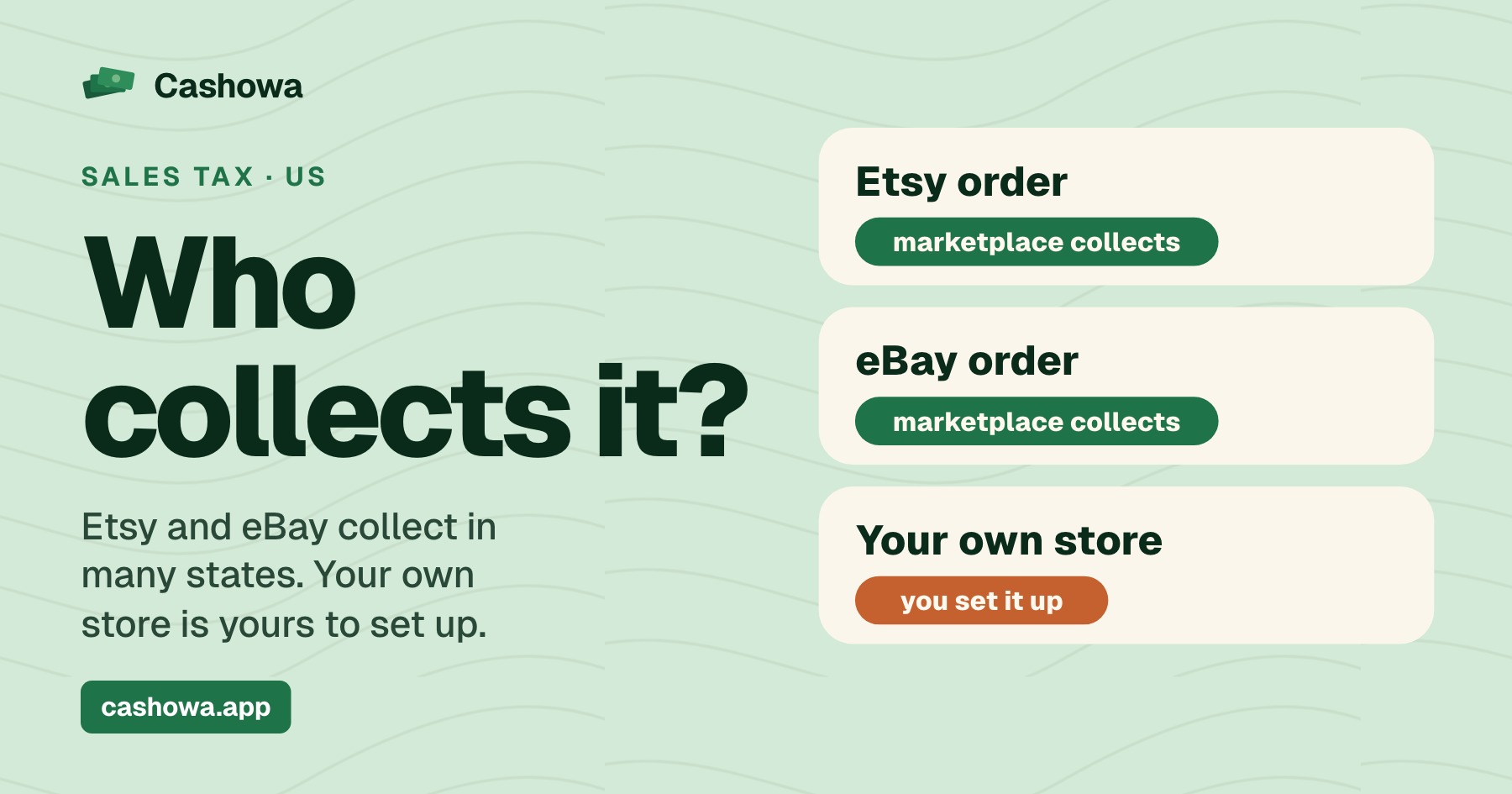
Sales tax for online sellers in the US depends on where you sell. On Etsy and eBay, the marketplace calculates, collects and remits sales tax on orders shipped to states that have marketplace laws, so you do not collect it on those orders. On your own Shopify or WooCommerce store, collecting it is yours to set up. This guide says what each marketplace does, what stays with you, and how to check your own situation. It is general information, not tax or legal advice.
Keep the monthly record your tax preparer asks for
See what Cashowa can doWhat a marketplace facilitator law does
Many states have laws that make the marketplace, rather than the seller, responsible for sales tax on sales made through it. Colorado's Department of Revenue explains one version in Sales & Use Tax Topics: Marketplaces, revised in September 2020. It defines a marketplace facilitator as a business that operates a marketplace and facilitates sellers' sales, and a marketplace seller as someone who sells through it. A facilitator must collect and remit the applicable state taxes on sales made through its marketplace.
For the seller, the publication says a marketplace seller who sells only through marketplaces is not required to obtain a Colorado sales tax license. A seller who also sells through another route, such as their own store or website, is a multichannel seller. For the sales a marketplace did not facilitate, a multichannel seller has the same licensing, collection, remittance, filing and recordkeeping requirements as any other retailer, with a small retailer exception under a $100,000 threshold for sellers with no place of business in Colorado. Colorado is one state. Yours may use different rules and different numbers, so check your own state's department of revenue.
What Etsy does
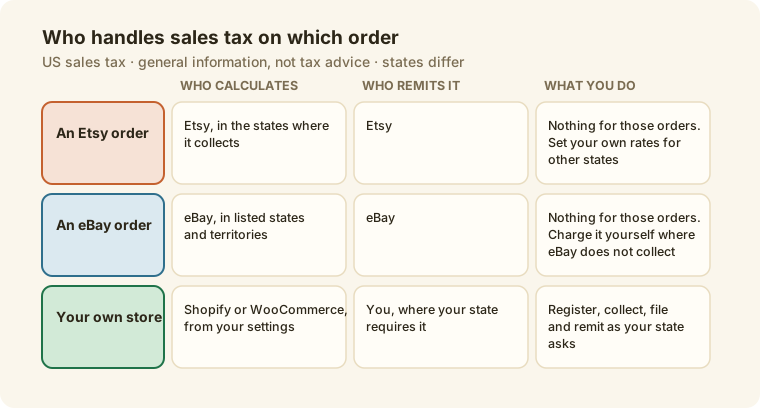
Etsy's help page on US state sales tax, read on November 16, 2026, says Etsy automatically calculates, collects and remits US sales tax when an order ships to a US recipient, or a US buyer purchases a digital order, and the order meets certain criteria. Sellers cannot opt out. For orders shipped to states where Etsy collects, sellers do not need to change their sales tax settings, and the settings in Shop Manager apply to states and regions where Etsy does not collect automatically. Etsy charges no extra fee for this service, and the article lists the states where Etsy collects, each with a start date. It also covers the Colorado Retail Delivery Fee, 31 cents on physical goods shipped to Colorado addresses, which Etsy remits and nets from the seller's gross sale like a tax. The remitted totals are in the Activity summary of your payment account.
What eBay does
eBay's help page on taxes says eBay, as a marketplace facilitator, calculates, collects and remits sales tax for items shipped to buyers in listed states and territories. Sellers do not need to take any action, there is no charge, and sellers cannot opt out. The page also says sellers are responsible for their own tax compliance: they may need to charge sales tax in some US territories where eBay does not collect it, and they can set up a tax table for that. It advises sellers to consult a tax professional and says eBay does not give tax advice. It mentions the 2018 Supreme Court ruling in South Dakota v. Wayfair, which removed the physical presence requirement for sales tax obligations, and it says some selling fees are themselves taxable in certain states, with the details on the seller's tax invoice. eBay's Seller Center page on tax information notes that sellers may need to track their sales across platforms for economic nexus thresholds, and that the Seller Hub Orders report itemizes the tax collected in marketplace states.
What stays with you on your own store
When you sell through your own website, no marketplace is collecting for you.
- Shopify. Shopify's setup checklist says it calculates taxes but does not file or remit them unless you use Shopify Tax automated filing.
- WooCommerce. WooCommerce's page on taxes says it calculates tax from the rates you define, and it does not say it files or remits for you. It describes an automated taxes setting added by the WooCommerce Tax extension, and says to confirm your obligations with a tax professional.
- Registering and filing. Whether you need a seller's permit, and when you file and remit, is set by your state. The SBA's page on paying taxes says tax rules vary by location and business structure, and it has a table with a link to each state's department of revenue.
Sales tax for online sellers: how to check your own situation
- List where you sell. Etsy, eBay, your own store, and any other channel.
- Check the marketplace's state list. Etsy's article and eBay's help page each list the states where they collect.
- Look at your own store's sales by state. Those are the sales no marketplace is handling.
- Open your state's department of revenue page through the SBA's table, and read what it says about marketplace sellers and about sales through your own website.
- Ask a tax professional if your own-store sales into a state are growing, because economic nexus thresholds are set by the state.
Income tax is a separate matter
Sales tax is collected from buyers and passed to the state. It is different from the income tax you owe on what your business earns, which is worked out on your profit. Form 1099-K for Etsy and eBay sellers covers the form that reports your marketplace payments.
Mistakes worth checking for
- Charging sales tax on an order a marketplace already collected for. eBay's page says the facilitator handles it where it collects.
- Assuming the marketplace covers your own store. It does not: the facilitator laws apply to sales made through the marketplace.
- Treating one state's rules as every state's. Colorado's publication is one example, and thresholds differ.
- Ignoring states where the marketplace does not collect. Etsy's Shop Manager settings apply there.
- Forgetting that some selling fees are taxable in some states. eBay's page lists several.
Where Cashowa fits
Sales tax itself is handled by the marketplaces, your own store's settings and your state, so the sections above are the whole answer. What Cashowa adds is the record. Cash flow sorts the statements you upload into categories and shows, month by month, what came in, what went out and what was left, which is the record a tax preparer asks for. What Cashowa can do shows each screen.
Frequently asked questions
Does Etsy collect sales tax for me?
Etsy's help page says it automatically calculates, collects and remits US sales tax on orders that ship to states where it is required and that meet certain criteria. Sellers cannot opt out, and the page lists the states.
Do I need a sales tax permit to sell on Etsy or eBay?
It depends on your state. Colorado's Department of Revenue says a marketplace seller who sells only through marketplaces does not need a Colorado sales tax license, and a seller who also sells through their own website does for those sales. Check your own state's department of revenue.
Do I charge sales tax on my own Shopify or WooCommerce store?
Both can calculate tax from the settings you give them. Shopify says it does not file or remit unless you use Shopify Tax automated filing, and WooCommerce's page does not say it files for you. Registering, collecting and filing are set by your state.
What is economic nexus?
A threshold of sales into a state, set by the state, above which a seller may have to register and collect there. eBay's help page says the 2018 Supreme Court ruling in South Dakota v. Wayfair removed the physical presence requirement for sales tax obligations, so a state can require it based on sales into it.
The term 'Etsy' is a trademark of Etsy, Inc. This Application uses Etsy's API, but is not endorsed or certified by Etsy. eBay, Shopify and WooCommerce are trademarks of their respective owners. Cashowa is independent and is not endorsed or certified by any of them.