Numbers for sellers· Kamal F 6 min read
How to Forecast Cash for a Seasonal Shop: the Q4 Rush and the January Slump
A 12-month method for a seasonal shop: take last year's months, add the delay between buying and being paid, and find the low point before the rush, with an invented example.
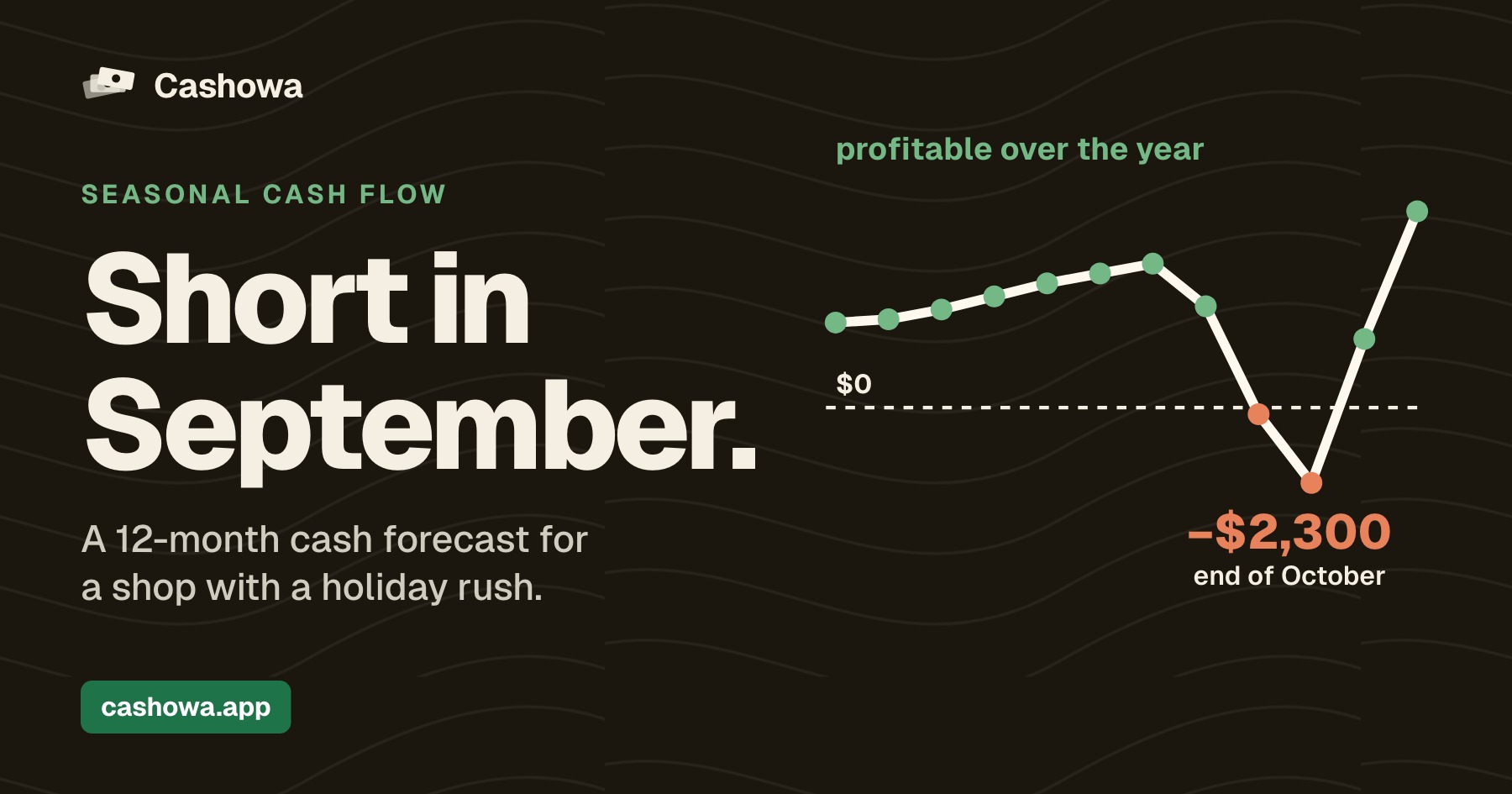
A cash flow forecast for a seasonal shop answers one question for each month of the year: how much cash will be in the account at the end of it? A shop with a holiday peak is usually profitable over the year and can still run short in September, because the materials for the peak are paid for before the sales arrive. This guide gives a 12-month method, uses an invented example to show the low point, and says where to look for the payout delay on Etsy and eBay.
Check how long your cash lasts
Open the cash runway calculatorWhy a seasonal shop needs its own cash flow forecast
A runway figure divides your cash by your monthly spending, which suits a shop with an even year. A seasonal shop's spending and income move in different months: money goes out for materials and ads before the rush, and comes in during it. How much runway do you actually have covers the even case. The question for a seasonal shop is not how long the cash lasts at today's burn but whether it stays above zero in the months before the peak pays.
The method, in six steps
- Take last year's twelve months. Money in and money out by month, from your statements.
- Mark the peak and the slump. Which months carried most of the year's income, and which were quiet.
- Move each cost to the month you pay it. Materials for November's orders are paid in August and September, not November.
- Move each sale to the month the cash arrives. Sales are not cash until they are paid out: see the next section.
- Add the changes you plan. A hire, an extra kiln, a larger materials order, a price change.
- Add it up. Start from the cash you have today, add each month's net, and look for the lowest point.
The delay between a sale and the cash
Etsy's help page on deposits says new sellers are paid weekly, every Monday, by default, and you can choose daily, biweekly or monthly deposits. It adds that updating your bank details puts a 5-day hold on the funds in your payment account, that Etsy may apply a reserve if it sees potential risk in your transactions, and that a standard transfer may take up to 1 to 5 business days to appear in your bank. eBay's page on getting paid says proceeds typically become available for payout within 48 hours of the buyer's payment, then eBay starts the payout on your schedule and your bank takes a few business days. A sale on the last days of a month often lands in the next month's cash.
A worked example
This is an invented shop: it opens the year with $2,500 in the account, and the numbers are chosen to show the pattern.
| Month | Cash in | Cash out | Net | Cash at month end |
|---|---|---|---|---|
| Jan | $3,100 | $3,000 | $100 | $2,600 |
| Feb | $2,900 | $2,800 | $100 | $2,700 |
| Mar | $3,300 | $3,000 | $300 | $3,000 |
| Apr | $3,500 | $3,100 | $400 | $3,400 |
| May | $3,400 | $3,000 | $400 | $3,800 |
| Jun | $3,200 | $2,900 | $300 | $4,100 |
| Jul | $3,200 | $2,900 | $300 | $4,400 |
| Aug | $3,500 | $4,800 | -$1,300 | $3,100 |
| Sep | $4,300 | $7,600 | -$3,300 | -$200 |
| Oct | $6,100 | $8,200 | -$2,100 | -$2,300 |
| Nov | $9,600 | $5,200 | $4,400 | $2,100 |
| Dec | $8,400 | $4,500 | $3,900 | $6,000 |
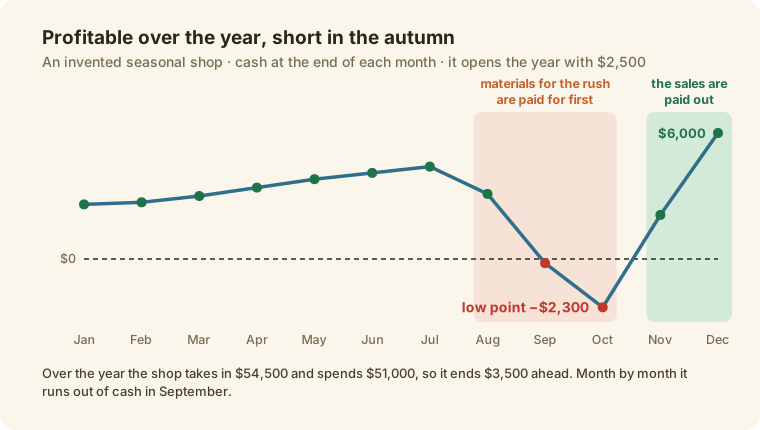
Over the year the shop takes in $54,500 and spends $51,000, so it ends $3,500 ahead of where it began. Month by month it is $200 short at the end of September and $2,300 short at the end of October, because the materials for November and December are paid for in August, September and October, before the orders pay out.
Use the low point
The lowest month-end figure, minus $2,300 in October, is the number to plan around. It tells you how much room you need. You can raise it by buying less in the months before the peak, asking a supplier for payment terms, or holding a cash buffer from the spring. A change shows up in the table at once: buy $1,500 less material in September, and the low point becomes minus $800, in October.
Mistakes worth checking for
- Forecasting profit instead of cash. The year above is profitable and still runs short.
- Counting a sale as cash when it is made. It arrives with the payout.
- Forgetting taxes and other lumpy bills. Put each in the month it falls due.
- Using a single month's pace for the whole year. The shape of last year's months is the best guide you have.
- Stopping at the year end. January follows the peak, and the quiet months are when the next materials order is due.
Where Cashowa fits
Cash flow shows your money in and out for the last 12 months from the statements you upload, which is step one of the method, and a quick way to see which months carried the year. The Forecast page draws the trend of your closed months with a range around it, and lets you add a named what-if, monthly or one-off, such as a second kiln or a part-time packer, and see the effect on your cash. For the months with a peak, read the forecast beside last year's same months from the method above. The free cash runway calculator gives the single figure for how long your cash lasts at a given pace. What Cashowa can do shows each screen.
Frequently asked questions
What is a cash flow forecast?
A month-by-month estimate of the money coming in and going out, ending in the cash you expect to have at the end of each month. It differs from a profit forecast because it follows when money moves, not when a sale is made.
Why can a profitable shop run out of cash?
Because costs are paid before the sales arrive. A seasonal shop pays for materials and ads before its peak and is paid out after the orders, so the cash can dip below zero while the year as a whole is profitable.
How far ahead should I forecast?
Twelve months covers a full season. Review it monthly and replace each forecast month with the real figure as it closes.
When do Etsy and eBay pay out?
Etsy pays new sellers weekly on Mondays by default and lets you choose daily, biweekly or monthly deposits, and a standard transfer may take up to 1 to 5 business days to reach the bank. eBay says proceeds typically become available within 48 hours of the buyer's payment, then pays out on your schedule.
The term 'Etsy' is a trademark of Etsy, Inc. This Application uses Etsy's API, but is not endorsed or certified by Etsy. eBay is a trademark of its owner. Cashowa is independent and is not endorsed or certified by it.