Saving & goals· Jane Wilson 6 min read
How Much Runway Do You Actually Have?
You have two runways and they are not the same number. Most people know roughly the first and have never once calculated the second.
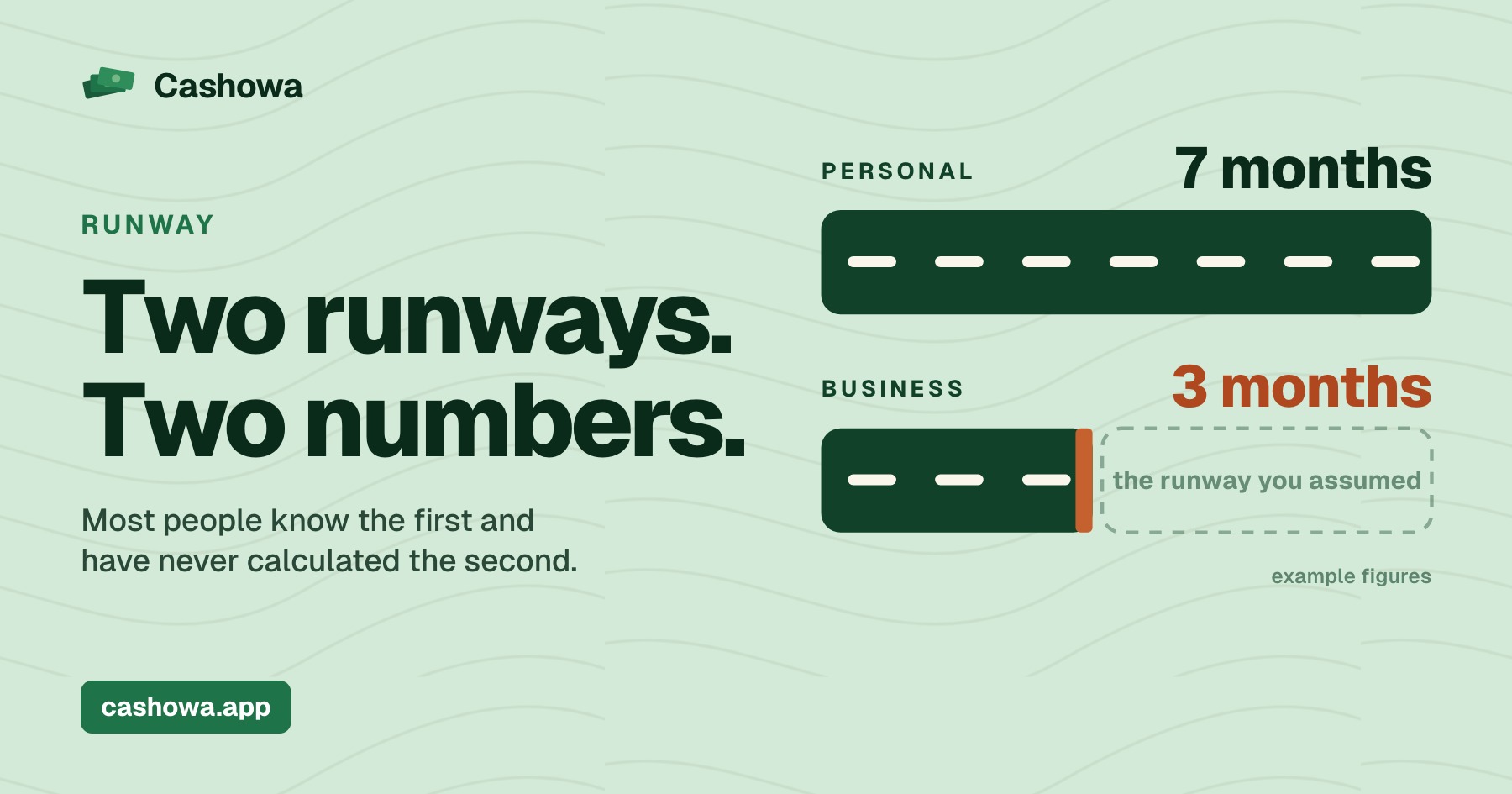
How much runway do you have? If you run anything — a freelance practice, a side business, a company with staff — the honest answer is probably "I'd have to work it out", and that is the problem. Runway is the number that determines which decisions are available to you, and it is almost never written down anywhere.
It is also two numbers, not one. Conflating them is how people end up making a business decision on a personal figure, or the reverse.
Work out both numbers from statements you already have
See your cash positionThe two numbers
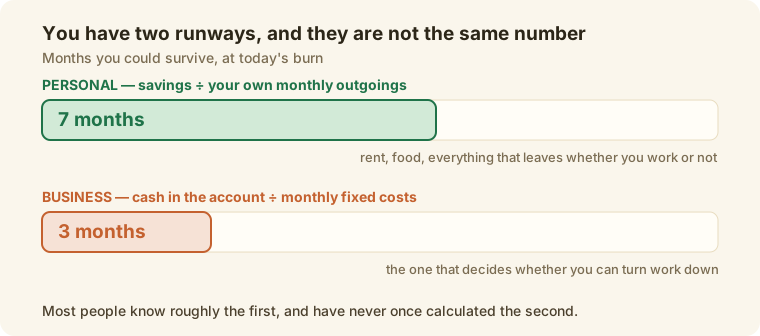
Personal runway. Accessible savings divided by your own monthly outgoings — rent or mortgage, food, bills, everything that leaves whether or not you work. This is the number that decides how long you could go without income.
Business runway. Cash in the business account divided by monthly fixed costs — the costs that continue whether or not you sell anything. Software, rent, retainers, salaries. This is the number that decides whether you can turn bad work down, survive a client leaving, or absorb a late payer.
They answer different questions and they are usually different sizes. A freelancer can have seven months of personal runway and three weeks of business runway, and the three weeks is the one that will force a decision.
How much runway you have: calculating both numbers
The arithmetic is trivial. Getting the inputs right is where people go wrong.
For personal runway, the mistake is using the wrong denominator. Not your average monthly spending — your committed monthly spending. Strip out the discretionary part, because in the scenario where you need runway you will cut it. Rent, utilities, insurance, debt payments, food, transport. The floor, not the average. Most people's floor is 60–70% of their normal spending, which means their real runway is considerably longer than a naive calculation suggests.
For business runway, the mistake runs the other way, and it is more dangerous. Three things get left out:
Money that is not yours. Sales tax or VAT you have collected belongs to the tax authority. Income and corporate tax accrue all year and arrive as one bill. Both sit in your account looking like runway and are not.
Stock. Inventory is not cash. It converts eventually, at a discount if you are in a hurry.
Invoices you have raised but not been paid for. They are not runway either. They are a hope with a date on it.
So business runway is spendable cash divided by unavoidable monthly cost — and the honest version of that number is usually a good deal shorter than the bank balance suggests.
What the number is for
Runway is not a vanity metric. It maps directly onto specific decisions.
Under one month. You are not running a business, you are reacting to one. Every decision gets made on urgency, which means you will take bad work at bad rates, and the bad rates are why the runway is short. This is the loop.
One to three months. You can plan a month ahead but cannot absorb a shock. One client leaving or one invoice going 60 days late becomes an emergency. Most freelancers live here and assume it is normal.
Three to six months. You can turn work down. This is the threshold where runway starts changing your pricing, because you no longer have to accept whatever is offered — and the pricing change is what extends the runway further.
Six months or more. You can make decisions that pay off later: a rebuild, a new product line, firing your worst client.
The point of knowing the number is that it tells you which of those four you are in, and people routinely believe they are one tier higher than they are.
Why nobody calculates it
Because it requires knowing your fixed costs separately from your variable ones, and almost nobody's records distinguish them. Bank statements are a flat list. "Monthly fixed costs" is not a line any bank produces, so you have to sort a year of transactions into recurring and not — which is a tedious afternoon, and therefore never happens.
That is the actual barrier. Not the division, the sorting. Once the recurring charges are identified the number falls out immediately, and it keeps falling out every month afterwards for free.
If you want the related read, why profitable businesses run out of money covers what happens when runway gets ignored while the profit figure looks fine.
Do it once, this week
Three steps, about forty minutes.
Pull three months of statements. Mark every charge that repeats — subscriptions, rent, insurance, retainers, loan payments. Add them up and divide by three: that is your monthly fixed cost.
Then take your genuinely spendable cash, after subtracting the sales tax, VAT and income tax you are holding, and divide. That is the number.
Write it down with today's date. Recalculate it on the first of every month. It is the single most decision-relevant figure in a small business and it takes a minute once the recurring charges are known.
Frequently asked questions
How do I calculate my runway?
Divide spendable cash by monthly fixed costs. For personal runway, use accessible savings divided by committed monthly outgoings. For business runway, use cash in the account — after deducting the sales tax, VAT and income tax you are holding — divided by the costs that continue whether or not you sell anything.
How many months of runway should a business have?
Three to six months of fixed costs is the point at which you can turn work down, which is also the point at which your pricing can improve. Under one month, every decision is made on urgency, which tends to keep the runway short.
Should unpaid invoices count towards runway?
No. An invoice you have raised but not been paid for is not cash. Counting receivables as runway is one of the main reasons businesses are surprised by a cash shortage while their accounts look healthy.
What is the difference between personal and business runway?
Personal runway is how long you could go without income, based on your own committed outgoings. Business runway is how long the business could trade without new sales, based on its fixed costs. They are usually different numbers, and the smaller one is the one that forces decisions.
Why is my runway shorter than my bank balance suggests?
Because some of the balance is not yours. Sales tax, VAT and accruing income tax all sit in the account and are owed. Stock is not cash, and invoices raised are not cash either.