Business· Jane Wilson 6 min read
The VAT Threshold Isn't Your Tax Year — It's Any Rolling 12 Months
Almost everyone who gets this wrong gets it wrong the same way: they check their turnover against the tax year. HMRC does not. Here is what the rolling window actually does.
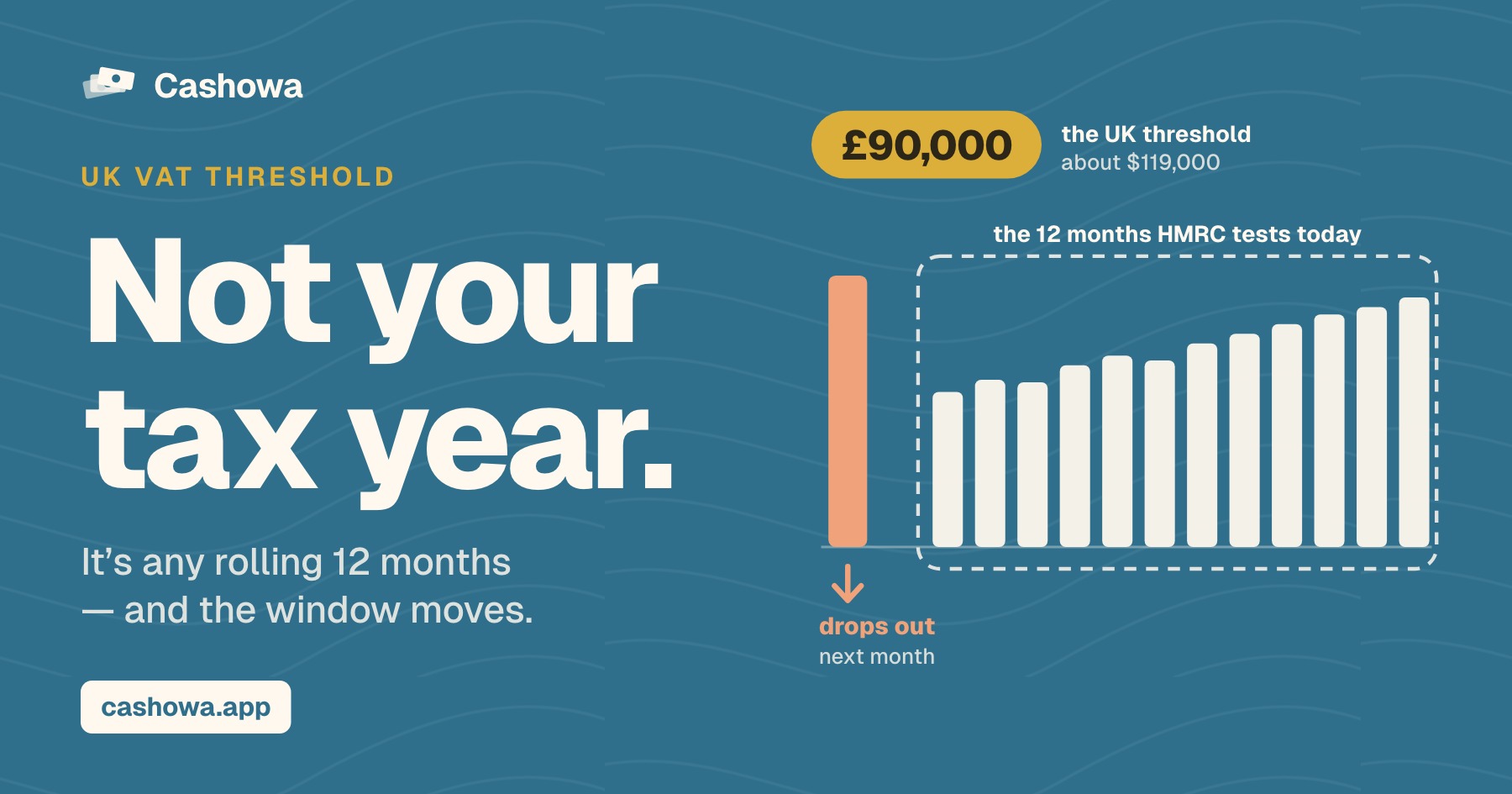
The UK VAT threshold is set in pounds (£), so the amounts in this article are in £. At about $1.32 to the pound, £90,000 is roughly $119,000.
The VAT threshold is £90,000, and it has been since 1 April 2024 — HMRC publishes the current figure on its VAT thresholds page. That part everybody knows. What catches people out is the period it is measured over, because almost every business owner who gets this wrong gets it wrong in exactly the same way: they compare their turnover to their tax year.
HMRC does not do that. The test is any rolling twelve months — count backwards twelve months from today, and from tomorrow, and from every day after that. You can be comfortably under for the year to date and already liable to register.
See the month you cross, and the two dates that follow
Open the free VAT threshold calculatorThat distinction sounds pedantic until you see what it does.
The window moves, and that has consequences
Because the twelve months being tested roll forward one month at a time, each new month means a month leaves the window. Which produces two results that nobody finds intuitive:
- Your rolling total can fall in a month you were paid well, if the month dropping out of the back was better still.
- It can rise in a month you barely worked, if the month dropping out was quieter than the one replacing it.
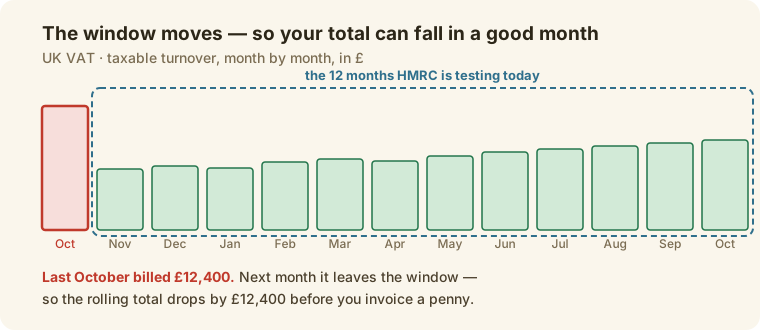
A spreadsheet with a running total only ever adds. So it is wrong in both directions, and the direction it is wrong in changes month to month. This is the single most common reason people either register when they did not have to, or discover months late that they should have.
It also means the useful question is not "what have I earned?" It is "what can I invoice next month without crossing?" — and the answer depends on what is about to leave the window, not on how much headroom you have today. A business with £4,000 of headroom and a £12,000 month about to drop out has far more room than the headroom figure suggests.
The VAT threshold has two tests, and this is only one
The rolling window above is the backward look. Register if your taxable turnover for the last twelve months goes over £90,000. You have 30 days from the end of the month in which you crossed — so crossing on 15 July gives you until 30 August, not 14 August. Your registration takes effect on the first day of the second month after you crossed: 1 September, in that example.
HMRC sets out both tests, with worked examples, in its guidance on when to register for VAT.
There is a second test that no calculator can run for you. The forward look: if you realize that your taxable turnover in the next 30 days alone will exceed £90,000, you must register by the end of that 30-day period, and your effective date is the day you realized — not the day the money arrives.
One large contract can trigger it on your first day of trading, with no history whatsoever. If you sign something that big, the backward look is irrelevant.
What counts as taxable turnover
This is where the second round of mistakes happens. Taxable turnover is the total value of everything you sell that is not exempt. Costs do not come off it — it is turnover, not profit.
Critically, zero-rated sales count in full. Zero-rated is not the same as exempt: it means taxable at 0%. Most children's clothing, books, and a great deal of food are zero-rated, which means a business selling them can sail past £90,000 having never charged a penny of VAT to anybody. What genuinely does not count is exempt supplies and anything outside the scope of VAT.
The expensive part of noticing late
Your effective date of registration is set by when you crossed, not by when you realized. Every sale from that date onwards owed VAT, whether or not your invoices showed any.
Register three months late and you owe HMRC a fifth of three months of sales, out of money your customers have already paid you and are not going to top up. Asking them for it afterwards rarely goes well. This is the entire argument for watching the rolling figure rather than checking it once a year with your accounts.
If you go over once and drop back
A single unusual month does not have to mean registration. You can apply to HMRC for an exception, showing that your taxable turnover over the next twelve months will stay below the deregistration threshold of £88,000.
It is a request, not a right — HMRC decides, and if they refuse, you are registered. Ask before the registration deadline rather than after it.
Staying under on purpose
It is entirely legal to turn work down, and a great many small businesses do exactly that around this line. The arithmetic is simple enough: if your customers are consumers, registering means either a 20% price rise or a 20% cut in your margin.
What you cannot do is split one business into two to keep both under. HMRC calls that disaggregation and will treat the parts as a single business. And if you are managing turnover deliberately, the figure that matters is not your headroom today but what drops out of the window next month — which is precisely the calculation a running total hides from you.
The other side of the argument: if you sell mainly to VAT-registered businesses, they reclaim whatever you charge them. Registering early costs your customers nothing and lets you reclaim VAT on your own purchases. Plenty of B2B freelancers register voluntarily well below £90,000 for that reason alone.
Frequently asked questions
What is the VAT registration threshold?
£90,000 (about $119,000) of taxable turnover in any rolling twelve months. It has been at that level since 1 April 2024. The deregistration threshold is lower, at £88,000 (about $116,000), so a business hovering around the line is not forced to register and deregister repeatedly.
Is the VAT threshold based on the tax year?
No. It is any rolling twelve-month period — the last twelve months counted backwards from wherever you are standing today, not April to April and not your own accounting year. This is the single most common misunderstanding about the threshold.
What happens when I go over the VAT threshold?
You must register within 30 days of the end of the month in which you went over. Your registration takes effect from the first day of the second month after you crossed, and you owe VAT on sales from that date — whether or not you added it to your invoices.
Do zero-rated sales count towards the VAT threshold?
Yes. Taxable turnover means everything you sell that is not exempt, and zero-rated goods are taxable at 0% rather than exempt. A business selling mostly zero-rated goods can cross the threshold without having charged any VAT at all.
What if I only went over the threshold once?
You can apply to HMRC for an exception from registering, if you can show your taxable turnover over the next twelve months will stay below the £88,000 deregistration threshold. HMRC decides, and if they refuse you are registered — so ask before the deadline, not after.