Numbers for sellers· Kamal F 7 min read
Estimated Quarterly Taxes for Etsy and eBay Sellers (US): Dates, Who Pays and How to Set Money Aside
Who has to make estimated payments to the IRS, the four due dates for tax year 2026, how to avoid a penalty, and one simple way to set money aside. General information, not tax advice.
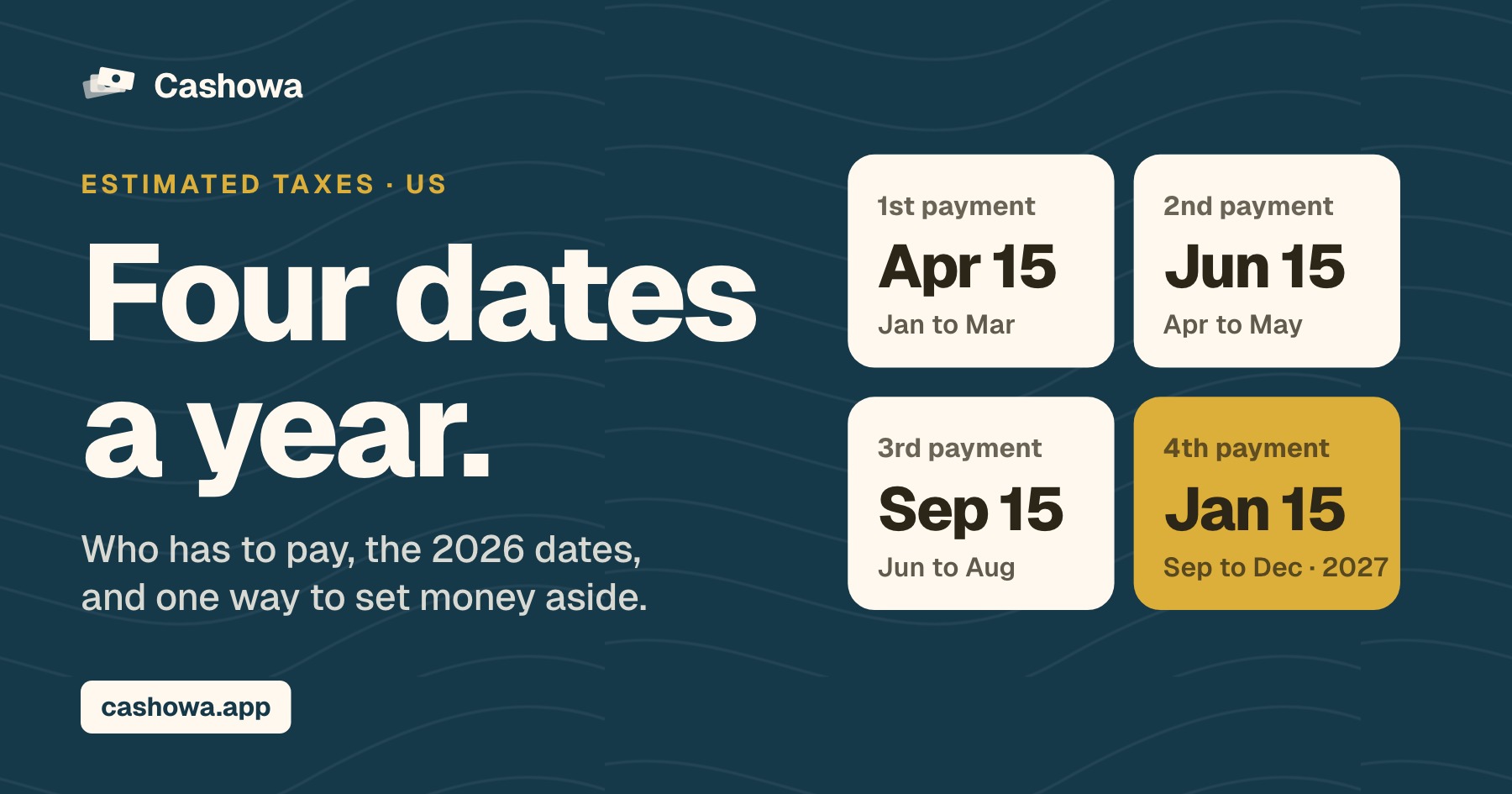
Estimated quarterly taxes are payments you make to the IRS during the year, ahead of your return, on income that is not taxed through withholding the way a paycheck is. If you sell on Etsy or eBay as a sole proprietor, this guide covers who has to make them, the four due dates for tax year 2026 as IRS Publication 505 lists them, how to avoid a penalty, and one simple way to set money aside from your own profit. It is general information from the IRS's own pages, not tax advice: your situation may differ, and a tax professional can check it against your return.
See your profit by month before you set money aside
What Cashowa can doWho has to make estimated quarterly taxes
The IRS page on estimated taxes, last reviewed on 25 September 2026, says individuals, including sole proprietors, partners and S corporation shareholders, generally have to make estimated tax payments if they expect to owe $1,000 or more when they file their return. IRS Publication 505 states the test in more detail: you expect to owe at least $1,000 in tax for 2026 after subtracting your withholding and credits, and your withholding and credits are less than the smaller of 90% of your 2026 tax or 100% of your 2025 tax.
Two things follow for a seller. The test is about the tax you expect to owe, not about the number of sales, so it is worth working out from your own profit. And the test counts withholding and credits, so a seller who also has a job may find that the tax taken from their wages already brings them under the line.
The 2026 due dates
Publication 505 lists four payment dates for tax year 2026, one for each part of the year:
| Income earned | Payment due |
|---|---|
| January to March | April 15, 2026 |
| April to May | June 15, 2026 |
| June to August | September 15, 2026 |
| September to December | January 15, 2027 |
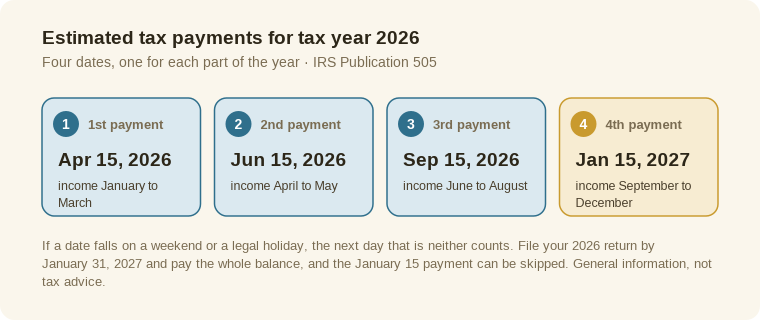
The January 2027 payment is the one still ahead if you are reading this in late 2026. Publication 505 adds that if you file your 2026 Form 1040 by January 31, 2027 and pay the whole balance due with the return, you do not need to make the January 15 payment. It also says that when a due date falls on a weekend or a legal holiday, a payment is on time if you make it on the next day that is neither.
How to avoid an underpayment penalty
The IRS estimated taxes page says most taxpayers avoid the penalty if they owe less than $1,000 after withholding and credits, or if they paid at least 90% of the current year's tax or 100% of the prior year's tax, whichever is smaller. Publication 505 adds that the prior-year figure becomes 110% if your adjusted gross income for 2025 was more than $150,000 (or $75,000 if you are married filing separately for 2026). The IRS's Topic no. 306 says payments are generally made in four equal amounts.
Here is the arithmetic of the prior-year route, with invented numbers. Suppose the total tax on your 2025 return was $4,200 and your 2025 adjusted gross income was under $150,000. Paying 100% of that in four equal amounts is $4,200 divided by 4, which is $1,050 on each date. That can keep you clear of the penalty even if 2026 turns out to be a better year, but it does not reduce what you owe: any balance is still due when you file. If 90% of your 2026 tax comes out lower than $4,200, the smaller figure is the one the rule asks for.
Seasonal sellers should know one more option. The IRS says that if your income is uneven during the year, Form 2210 can help lower the penalty by annualizing it. A shop that earns most of its profit in November and December is exactly that case, and a tax professional can say whether it applies to you.
What the payments are for: income tax and self-employment tax
Self-employment tax is a separate tax from income tax. The IRS page on self-employment tax, reviewed on 30 October 2026, gives the rate as 15.3%, made up of 12.4% for Social Security and 2.9% for Medicare. It applies when your net earnings from self-employment are $400 or more, and for 2026 the Social Security part applies to the first $184,500 of combined wages, tips and net earnings. It is reported on Schedule SE.
The practical point is that your profit, not your sales, is what gets taxed, and that the tax comes in more than one kind. That is why the set-aside below starts from last year's total tax rather than from a rate you would have to guess.
One way to set money aside
The IRS pages do not give a percentage to set aside, so use your own return. Take the total tax from last year's return and divide it by last year's net profit. With invented numbers: $4,200 of total tax on $24,000 of net profit is 4,200 divided by 24,000, which is 0.175, or 17.5%. If this month's profit is $2,000, you move 2,000 times 0.175, which is $350, into a separate savings account. When the January date comes, the money is already there.
Treat the percentage as a starting rule, not a prediction. Income tax rates rise with income, your state may tax income too, and your profit this year may be very different. Check it each quarter against your actual profit, and against what a tax professional or your tax software tells you.
How to pay
Publication 505 lists several ways to pay estimated tax: through your IRS online account, with IRS Direct Pay, by debit or credit card (a fee applies), with an electronic funds withdrawal when you file, through EFTPS (you enroll first, and there is no fee), with the IRS2Go app, or by check or money order with a Form 1040-ES payment voucher. Whichever you use, keep the confirmation: your payments are records, and the IRS says to keep records that support what you report. Our guides to bookkeeping for online sellers and the year-end checklist for online sellers cover the records side.
Where Cashowa fits
Cashowa does not calculate, withhold or file tax, and it does not give tax advice. What it can do is give you the profit figure the set-aside starts from. Its Cash flow page reads the statements you upload and shows your revenue, your costs and your net margin over time, with a breakdown of costs by category. On the plans that include Forecast (see pricing), you can enter a payment such as the January 15 date as a one-off amount and see what it does to your cash. What Cashowa can do shows each screen.
Frequently asked questions
Who has to pay estimated quarterly taxes?
Individuals, including sole proprietors, generally have to if they expect to owe $1,000 or more when they file, after withholding and credits. Publication 505 adds that your withholding and credits must also be less than the smaller of 90% of this year's tax or 100% of last year's.
When are estimated taxes due in 2026?
April 15, June 15 and September 15, 2026, and January 15, 2027, according to the table in IRS Publication 505. If a date falls on a weekend or legal holiday, a payment made on the next day that is neither is on time.
Does a Form 1099-K mean I have already paid tax?
No. The IRS describes Form 1099-K as a report of payments you received for goods or services, and it says you must still report any income whether or not you receive the form. For what the form counts and why it differs from your payouts, see our guide to Form 1099-K for Etsy and eBay sellers.
Can I skip the January payment?
Publication 505 says you do not need to make the January 15, 2027 payment if you file your 2026 return by January 31, 2027 and pay the entire balance due with it.
How do I pay?
Through your IRS online account, IRS Direct Pay, EFTPS, the IRS2Go app, by card (with a fee) or by check or money order with a Form 1040-ES voucher, as Publication 505 lists them.
The term 'Etsy' is a trademark of Etsy, Inc. This Application uses Etsy's API, but is not endorsed or certified by Etsy. eBay is a trademark of its owner. Cashowa is independent and is not endorsed or certified by it.