Numbers for sellers· Jane Wilson 7 min read
Cost of Goods Sold for Handmade Products: What Goes on Schedule C
What counts as cost of goods sold for a maker, how Schedule C lines 35 to 42 work, a worked example with a cost per item, and what is not part of it. General information, not tax advice.
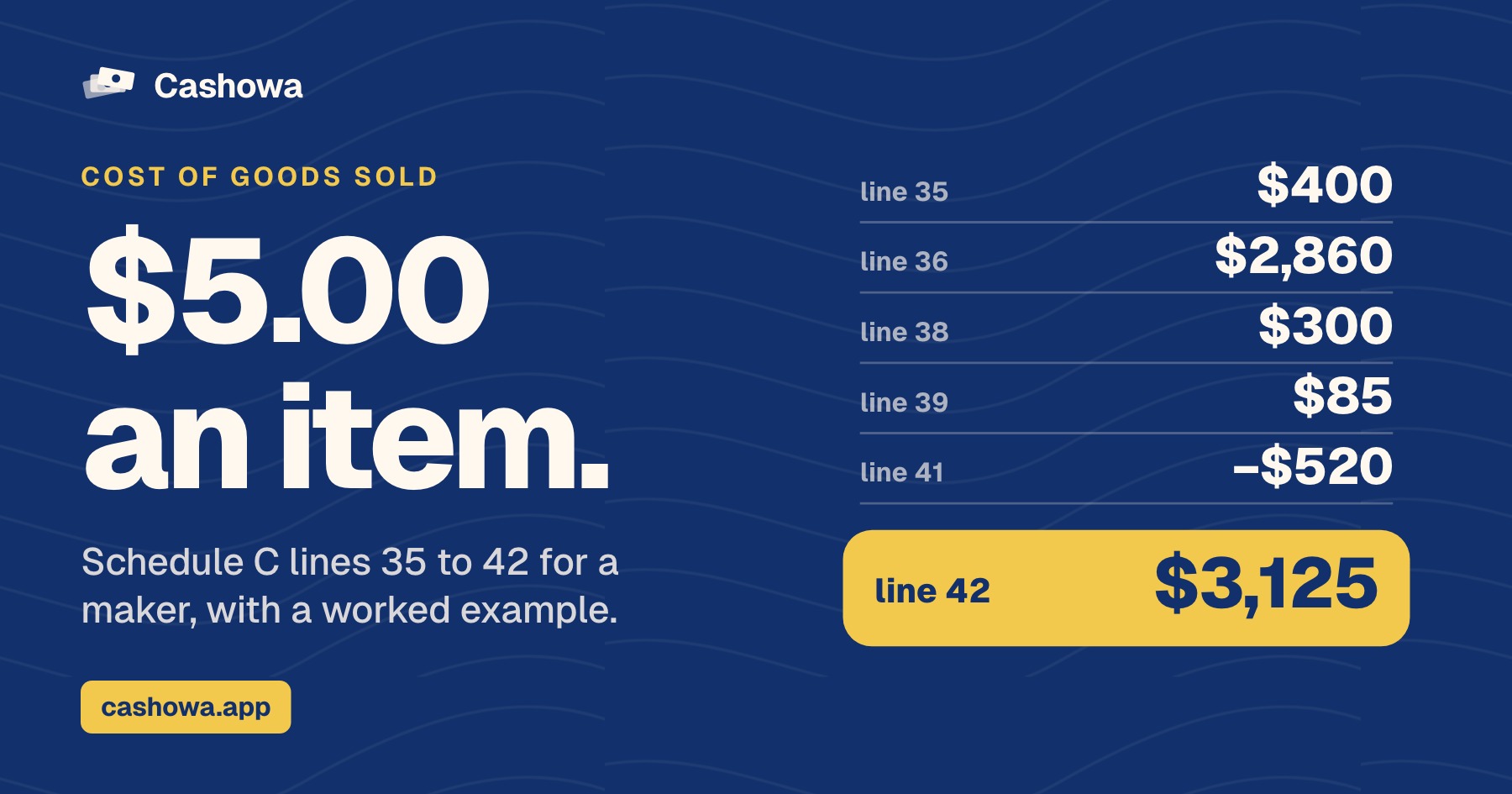
Cost of goods sold is what it cost you to make or buy the products you sold during the year, and on a US tax return it is worked out in Part III of Schedule C. For a seller who makes things, it is the number that turns materials and supplies into a cost per item, and the number that decides how much of your sales is profit. This guide explains Schedule C lines 35 to 42 in plain words, what a maker puts on each, a worked example with a cost per item, and what is not part of it. It is general information from the IRS's Publication 334 and the Schedule C instructions for 2025, not tax advice, and a tax professional can tell you how it applies to your return.
Work out how many sales cover your costs
Try the break-even calculatorWhat cost of goods sold is
It is a sum: what you held at the start of the year, plus what you added during it, minus what you still held at the end. The IRS lays it out in Part III of Schedule C, and Publication 334, the IRS's tax guide for small business, explains each line.
| Line | What it is |
|---|---|
| 35 | Inventory at the beginning of the year. If it differs from last year's closing inventory, attach an explanation |
| 36 | Purchases, less the cost of items you took for personal use |
| 37 | Cost of labor. Do not include any amounts paid to yourself |
| 38 | Materials and supplies |
| 39 | Other costs |
| 40 | Add lines 35 through 39 |
| 41 | Inventory at the end of the year |
| 42 | Subtract line 41 from line 40. This is your cost of goods sold, and it goes on line 4 |
What a maker puts on each line
Line 35, the start of the year. What you held on January 1, valued at what it cost you: finished goods and the materials you had not yet used.
Line 36, purchases. Publication 334 says a manufacturer's purchases include raw materials and parts. Use the prices you actually paid, less returns and allowances. Sales tax on goods you buy for resale is part of their cost. If you take a finished item for yourself, its cost comes out of purchases.
Line 37, labor. Wages for people who help you make the product. Publication 334 says labor is usually part of cost of goods sold only for manufacturing or mining, that a sole proprietor is not an employee, and that your own pay and withdrawals are not deductible. So if you make everything yourself, line 37 is usually zero, and your own time is not a cost here.
Line 38, materials and supplies. Publication 334 says materials and supplies used in manufacturing go to cost of goods sold, and other supplies are expensed when used.
Line 39, other costs. The page lists containers that are an integral part of the product, freight-in on raw materials, production supplies and goods you buy for resale, and overhead that is a direct and necessary expense of the manufacturing operation.
Lines 40 to 42. Add lines 35 through 39, take away the closing inventory on line 41, and the result on line 42 is the cost of the goods you sold.
What is not cost of goods sold
The IRS says a container that is not an integral part of the product is a shipping or selling expense, and it lists advertising among business expenses. In the same way, postage you pay to send an order to a buyer, a shipping box and a marketplace's fees are selling and shipping costs that belong on other lines of Schedule C, and not in cost of goods sold. Where each one goes is a question for a tax professional. Freight-in, the cost of getting materials to you, is part of cost of goods sold.
A worked example
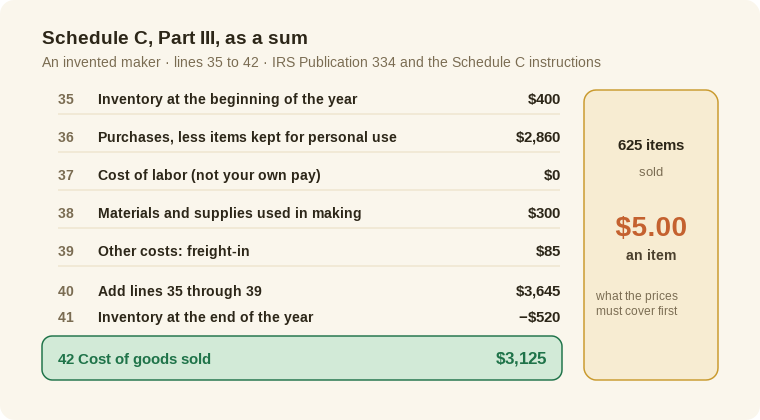
An invented ceramics maker, with every figure counted by code:
| Line | What | Amount |
|---|---|---|
| 35 | Inventory at the beginning of the year | $400 |
| 36 | Purchases (clay and glazes), less items kept for personal use | $2,860 |
| 37 | Cost of labor (not the maker's own pay) | $0 |
| 38 | Materials and supplies used in making | $300 |
| 39 | Other costs: freight-in on the clay | $85 |
| 40 | Add lines 35 through 39 | $3,645 |
| 41 | Inventory at the end of the year | $520 |
| 42 | Cost of goods sold (line 40 less line 41) | $3,125 |
The maker sold 625 items, so the cost of goods sold is $5.00 an item. That figure is what the prices have to cover first, before postage, marketplace fees, advertising, the maker's own time and tax. Our guide to how to price a product works from what you need to keep back to the price, and break-even for an online store turns the costs into a number of sales.
How to value inventory
The Schedule C instructions say inventory can be valued at cost, at the lower of cost or market, or by another method the IRS approves. Publication 334 says your inventory practices must be consistent from year to year, and that changing a method needs the IRS's approval on Form 3115. Count what you hold at year end, write down what each item cost, and keep the count sheet with your records. Our year-end checklist puts the count among the steps.
Do you have to keep inventory?
Not always. Publication 334 and the Schedule C instructions say a business with average annual gross receipts of $31 million or less for the three prior tax years (a figure the IRS adjusts for inflation), and that is not a tax shelter, may choose not to keep inventories. Its accounting method still has to clearly reflect income, and the pages describe two approaches: treating the inventory as non-incidental materials and supplies, deducted when first used or consumed, or following the treatment in its financial accounting. Whether this applies to you, and which approach suits you, is a question for a tax professional. The same publication says small business taxpayers are exempt from the uniform capitalization rules that otherwise require some indirect production costs to be added to inventory.
Where Cashowa fits
Cashowa does not value your inventory or prepare Schedule C. What it does help with is the cost per item. The Products & orders page has a table where you enter what each item costs you, so your sales show as profit and not only revenue, and the Cash flow page shows revenue, costs and net margin over time from the statements you upload. The free break-even calculator turns your costs and per-sale costs into a number of sales. How Cashowa works for sellers says what it reads and keeps.
Frequently asked questions
What is included in cost of goods sold for handmade products?
The inventory you started the year with, what you bought to make and sell (materials, parts and supplies used in making), freight-in, and other costs directly necessary to making the item, less what you still hold at the end of the year. Publication 334 sets this out, and a tax professional can say how it applies to you.
Is my own labor part of cost of goods sold?
Not your own pay. The Schedule C line for labor says not to include amounts paid to yourself, and Publication 334 says a sole proprietor is not an employee and that your own salary and withdrawals are not deductible.
Is shipping part of cost of goods sold?
The cost of getting materials to you (freight-in) is. Postage you pay to send an order to a buyer, and a box that is not an integral part of the product, are shipping or selling costs, which go on other lines.
Do I have to count inventory?
If you keep inventory, you value it each year for Part III. The IRS pages describe an exception for businesses with average annual gross receipts of $31 million or less over the three prior years, which may choose not to keep inventories. Ask a tax professional which applies to you.