Platform guides· Jane Wilson 6 min read
The Downsides of Selling on Etsy, and Who They Matter To
Fees that add up, a reserve and a payout wait for new sellers, rules that change, competition and a platform you do not own: the downsides of selling on Etsy, with figures.
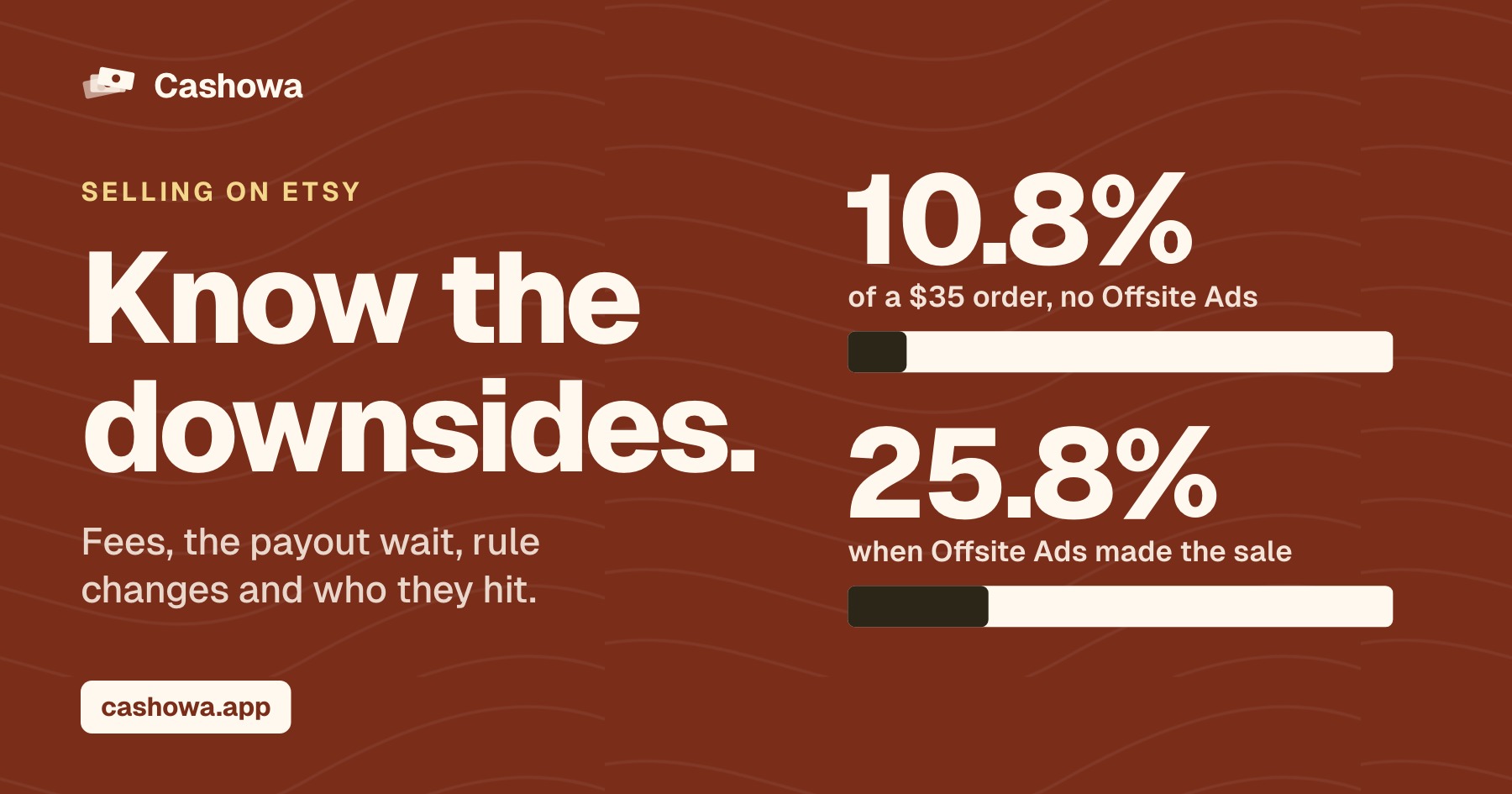
The downsides of selling on Etsy are real and mostly knowable in advance: fees that stack up on every sale, a reserve and a wait for new sellers' money, rules that Etsy can change, a crowded marketplace and shoppers who belong to Etsy and not to you. None of them is a reason not to sell there, because the same shop also reaches about 88 million active buyers. They are reasons to price carefully, plan your cash and keep your own records. This guide sets each one out with figures from Etsy's own pages, read on November 23, 2026, and says who it matters to most.
Work out what an Etsy sale leaves you
Try the Etsy fee calculatorThe downsides of selling on Etsy, one at a time
Seven downsides follow, each with a figure from Etsy's pages where there is one and a note on who it hits most.
1. The fees add up
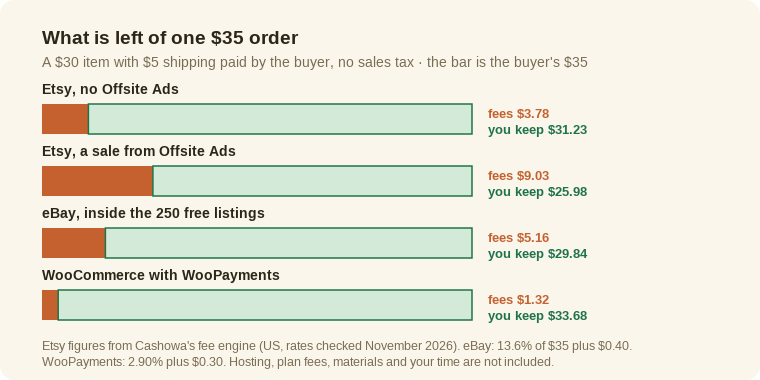
Etsy's page on fees and taxes lists a $0.20 listing fee, a 6.5% transaction fee on the item and shipping, a payment processing fee (3% plus $0.25 for a US seller, on the order total) and a one-time shop set-up fee. For a $30 item with $5 shipping, Cashowa's fee engine gives $3.78 in fees, 10.8% of the $35, leaving $31.23. If the sale comes from Etsy's Offsite Ads, which charge 15% of the order total for a seller who made less than $10,000 on Etsy in the past 365 days and 12% at $10,000 or more, capped at $100 an order, the fees on the same order are $9.03, 25.8%, leaving $25.98. Our guide to Etsy fees goes through each.
Who it hits: sellers with thin margins, who need the fee calculator before they set a price.
2. New sellers wait for their money
Etsy's help pages say a new seller's funds are generally eligible for deposit 14 days after a sale, and that a reserve may hold a percentage of each new sale of a physical item, removed within 90 days for most sellers. A new seller's deposit schedule defaults to weekly. Our guide to the Etsy payout schedule follows one sale from the order to the bank, which for a new seller can take three to four weeks.
Who it hits: new sellers buying materials up front, and anyone with a busy December.
3. The rules change, and you have to follow them
Etsy has been tightening its rules on AI and photos. Its community announcement, Updated Nov 6: Important updates to AI on Etsy, restricts bot-generated listings and AI-generated functional guides, and says most listings need at least one unedited photo of the real item, with enforcement planned for early 2027. What you can sell is also limited: Etsy's page on what you can sell says it must be made, designed, handpicked or sourced by you, and reselling mass-produced items is not allowed, with limited exceptions. Our guide to what Etsy and eBay say about AI in listings covers the AI rules.
Who it hits: sellers who use AI tools or edit every photo, and sellers who buy in finished goods to resell.
4. Search is Etsy's, and not published
Etsy has not published how much any signal counts in its search, and no one outside Etsy can say. You can make a listing complete and clear, and you cannot see inside the ranking.
Who it hits: sellers who expect a fixed formula to optimize against.
5. A large marketplace is a crowded one
Digital Commerce 360's report on Etsy's third-quarter 2025 results gives 5.5 million sellers, and Etsy's third-quarter 2026 shareholder letter says its seller base grew at its fastest rate in two years. More sellers means more competition for the same shoppers, and a listing that looks like thousands of others has little to set it apart.
Who it hits: sellers of items many others also sell.
6. The shoppers belong to Etsy
On a marketplace, the buyer found Etsy, and Etsy's rules govern how a shop deals with them. In a store of your own, the customer is yours, and so is the work of bringing them. Our guide to Etsy, Shopify, WooCommerce and eBay side by side compares the two models.
Who it hits: sellers building a brand they want to own.
7. Setting up is a process
Opening a shop needs two-factor authentication, an identity check, a bank account, a card, tax details and a first listing, and Etsy charges a one-time, non-refundable set-up fee, whose amount the pages we read do not state. Our guide to the requirements to be an Etsy seller lists them.
Who it hits: anyone who wants to be selling today.
The other side
About 88 million active buyers, per Etsy's Q3 2026 shareholder letter, is a large audience, and Etsy handles payments, buyer protection tools and the storefront for the fees above. For many sellers the fees buy reach they would not otherwise have. The downsides above matter most when your margin is thin, your cash is tight or your product is easy to copy.
Where Cashowa fits
Cashowa cannot change what Etsy charges. What it can do about the downsides you can influence: its fee tool shows what each Etsy sale leaves you, its store health check lists every active listing that is thin, short, duplicated or missing alt text or tags, and it can draft fixes for your approval, check that each landed and let you undo it. Its Cash flow page and free cash runway calculator help with the payout gap. How Cashowa works for sellers says what it reads and keeps.
Frequently asked questions
What are the main downsides of selling on Etsy?
Fees that stack up, a reserve and a payout wait for new sellers, rules that change (on AI and photos in 2026), a crowded marketplace, a search ranking Etsy has not published, and shoppers who belong to Etsy and not to you.
Is selling on Etsy worth it?
It depends on your margin and your cash. Etsy reaches about 88 million active buyers per its Q3 2026 shareholder letter. For a $35 order, the fees are about $3.78 without Offsite Ads and $9.03 with them, so check what a sale leaves you before you price.
Why do new Etsy sellers wait so long to be paid?
Etsy's pages say funds are generally eligible 14 days after a sale for new sellers, and that a reserve may hold a percentage of each new sale of a physical item for up to 90 days for most sellers. Adding valid tracking can release it sooner.
Can I sell on Etsy and somewhere else?
Yes. Many sellers use Etsy alongside their own store or another marketplace, and our guide to selling on more than one marketplace covers how, including keeping the stock count in one place.
The term 'Etsy' is a trademark of Etsy, Inc. This Application uses Etsy's API, but is not endorsed or certified by Etsy. eBay, Shopify and WooCommerce are trademarks of their respective owners. Cashowa is independent and is not endorsed or certified by any of them.