Platform guides· Jane Wilson 7 min read
Are Sellers Leaving Etsy? What the Numbers Say, Whether AI Listings Are the Problem, and How Cashowa Differs
What Etsy's own reporting says about its seller count, whether AI-generated listings are a problem, and how Cashowa keeps a person in charge of every change.
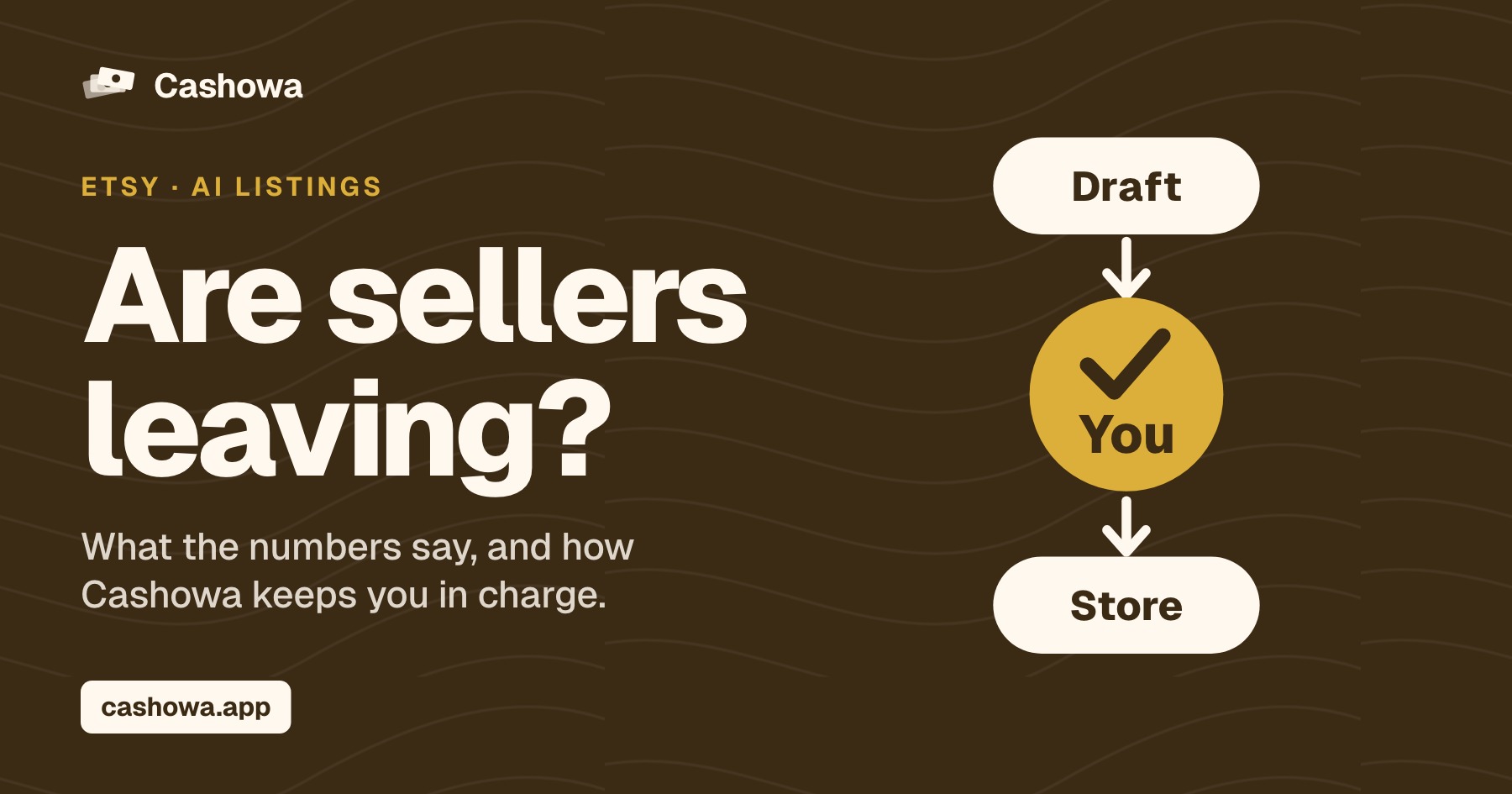
Are sellers leaving Etsy? The idea has some basis in 2025 and less in Etsy's latest report. Digital Commerce 360's coverage of Etsy's third-quarter 2025 results gave 5.5 million sellers, down 10.9% from a year earlier. Etsy's third-quarter 2026 shareholder letter, signed October 28, 2026, says its seller base grew at its fastest rate in two years and that seller retention is improving. Neither document says why any one seller left, and neither says AI-generated listings are the cause. They do not rule it out as a worry either: Etsy's own letter says AI makes it easier to create, replicate and sell products at scale. This guide sets out what we can and cannot say about why sellers leave, whether AI listings are a problem, and how Cashowa is built so that it is not a machine for producing them.
See what is holding your listings back
How Cashowa works for sellersSellers leaving Etsy: what the numbers say
- 2025. Digital Commerce 360's report on Etsy's third-quarter 2025 results gives 5.5 million sellers, down 10.9% year over year and up 1.7% from the second quarter. Its paraphrase of Etsy's finance chief ties the sequential rise to the effect of the shop set-up fee beginning to ease.
- 2026. Etsy's third-quarter 2026 shareholder letter says the seller base grew at its fastest rate in two years and that seller retention is improving. It reports about 88 million active buyers, up 1.0% from a year earlier and the first annual increase in two years. The table with exact seller counts is an image we could not read.
So in Etsy's own reporting the number of sellers fell in 2025 and then turned. That is a count of active sellers, and it cannot tell you why a seller left, how many sellers closed shops, or whether those who left were the ones that Etsy wanted to keep.
Why sellers say they leave
We found no survey of sellers who left, and Etsy's filings do not say. What the pages we read do show are the costs and rules sellers have to live with, set out in our guide to the downsides of selling on Etsy: fees that stack up, a reserve and a payout wait for new sellers, rule changes and a crowded marketplace. A seller deciding whether to stay is weighing those against about 88 million buyers.
Is AI-generated listing a problem?
For Etsy it is something it names. The letter says AI makes it easier to create, replicate and sell products at scale, and that Etsy therefore sees the human touch as mattering more, pointing to clearer policies, stronger enforcement and product changes. Etsy's community announcement, Updated Nov 6: Important updates to AI on Etsy, says AI should support your creativity and craftsmanship and not replace them. It describes tighter limits on listings made with AI, including prohibiting bot-generated listings and AI-generated functional guides, and requires at least one unedited photo of the real item for most listings, with enforcement planned for early 2027. Our guide to what Etsy and eBay allow has the detail, including what the pages do not say.
What people call AI slop has recognizable signs: a listing nobody read, facts nobody checked, the same wording on a hundred products, a pile of repeated keywords, photos that do not match what arrives. Those are a problem for buyers, for honest sellers who have to compete with them, and for any seller whose listing is swept up with them.
How Cashowa works, and why it is not that
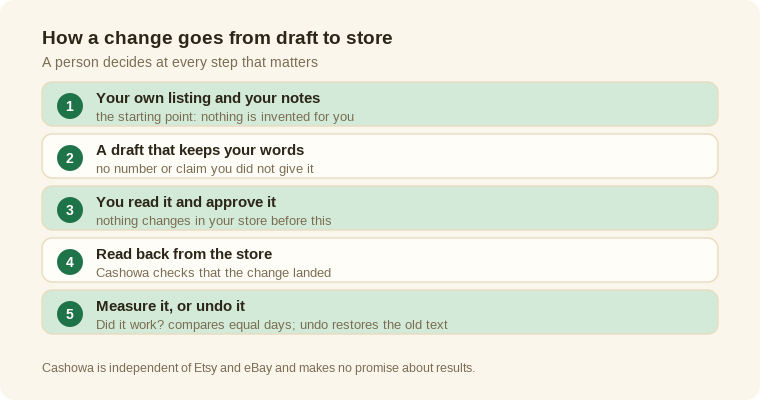
Cashowa is for sellers who want help with their own listings, and it is built so that a person stays in charge of every change. Here is how each point answers a sign above.
| The sign of slop | What Cashowa does instead |
|---|---|
| Nobody read it | Nothing changes in your store until you approve it. A suggestion waits, you read it, and you can undo it afterwards |
| Facts nobody checked | The writer keeps your words and refuses a number, or a safety, certification, health, origin, ranking, shipping or discount statement, that is not in your own text. If a field fails the check it is asked for again once and then left out |
| The same wording everywhere | It starts from each listing's own text and your own notes, so a mug's description comes from that mug |
| A pile of keywords | It keeps every keyword you used, joins exact repeats, and refuses emoji and shouting capitals |
| Photos that do not match | It never writes about the photo, and it never changes your photos on a store. Etsy's and eBay's photos are never sent to the model |
| Mass publishing | It improves listings you already have, or drafts a new one from your notes and photos for you to approve |
Three more things are worth saying plainly. Cashowa does not research keywords or look at other sellers' shops, and its writing draws on what the model knows about how shoppers search for that kind of product, never a fact about yours. It reads each change back from the store to check it landed. And Did it work? compares the 14 days before and after using the sales reports you upload, leaves the change day out and sets the product against the rest of your shop, so a result is measured and not assumed.
Why it is more efficient, honestly
The work in a store is not the thinking, it is the retyping and the hunting. Cashowa checks every active listing at once and shows the checks passed over the checks run, so you start with the weakest, writes suggestions you read instead of blank forms, can write suggestions for many listings in one go for you to go through, copies a listing to another of your stores as a draft, and can clean up a photo you upload. It saves time on the mechanical steps and leaves the judgment where it belongs. It cannot promise that a listing will sell more, and no honest tool can.
Within the rules, as Etsy has published them
Etsy's pages restrict bot-generated listings and AI-generated functional guides, and ask for an unedited photo and a disclosure for AI-created items. Cashowa is built around those lines as we read them: a person approves every change, it does not generate shops or publish listings on its own, it does not touch the photo you keep unedited, and where it uses AI the result is a suggestion with your words in it. Cashowa is independent of Etsy, nothing here says that Etsy approves of any tool, and the policies can change, so read Etsy's pages yourself too. The honest limit is that nobody but Etsy can say how it will treat a given listing, which is why a person in the loop matters.
Frequently asked questions
Are sellers leaving Etsy in 2026?
Etsy's third-quarter 2026 shareholder letter says its seller base grew at its fastest rate in two years and that seller retention is improving. The seller count fell in 2025, per Digital Commerce 360's report on its third-quarter 2025 results, and then turned.
Is AI-generated content banned on Etsy?
Not entirely. Etsy's announcement says it is prohibiting bot-generated listings and AI-generated functional guides such as patterns, recipes and instructions, and its help page says AI-generated art and products are allowed with a clear creative role and a disclosure. The pages we read do not address AI help with listing text.
Is Cashowa just AI-written listings?
No. It writes suggestions from your own listing and notes, keeps your words, refuses facts you did not give it, waits for your approval, checks the change landed and can undo it. It also checks every listing, copies listings between your stores, cleans up your photos and measures what a change did.
Will using Cashowa get my Etsy shop in trouble?
Nobody but Etsy can say how it will treat a given listing, and we make no promise about it. Cashowa keeps a person in charge of every change, and you remain responsible for what you publish, so read each suggestion and check Etsy's current pages.
The term 'Etsy' is a trademark of Etsy, Inc. This Application uses Etsy's API, but is not endorsed or certified by Etsy. eBay is a trademark of its owner. Cashowa is independent and is not endorsed or certified by it.