Platform guides· Thomas Cuccittini 6 min read
Shopify Product SEO: Page Title, Meta Description, URL Handle and Alt Text
Where the search engine fields of a Shopify product are, how long each should be according to Shopify's own pages, and what to put in each.
Shopify product SEO comes down to a handful of fields on the product page: the page title, the meta description, the URL handle and the alt text of each photo. Shopify's own pages give lengths for several of them, and a product title and description feed the rest. This guide shows where the fields are, the figures Shopify gives for each, what Shopify generates for you, and a worked example for an invented product. It does not say how much any field counts in a search engine, because Shopify's pages do not say, and nobody outside a search engine can.
See what is holding your listings back
How Cashowa works for sellersWhere the Shopify product SEO fields are
In your Shopify admin, open Products, select the product, and look for the Search engine listing section, where a pencil icon opens the fields. Per Shopify's page on adding and updating products, the section holds a page title, a meta description and the URL handle. Each photo's alt text is set from the product's media.
The page title
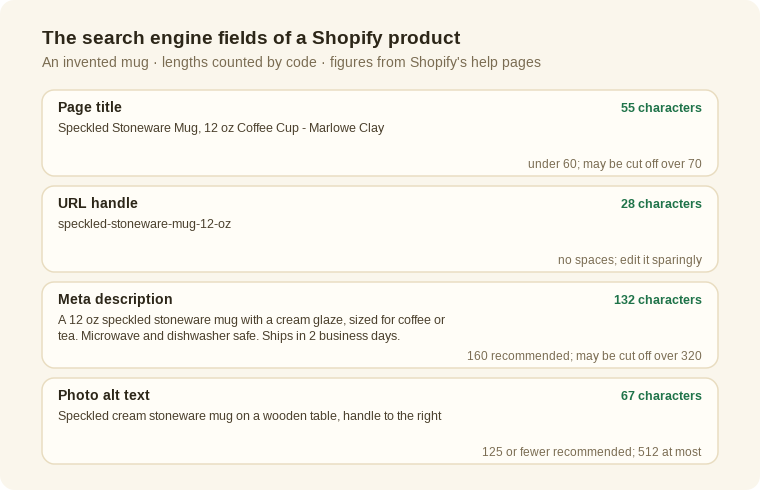
The page title is the headline a search result shows. Shopify's pages give two figures that agree: its SEO overview lists a title tag of fewer than 60 characters, and its page on adding keywords says you can enter up to 70 and suggests keeping to 60. Shopify's product page says a title over 70 characters might be cut off in search results.
The same page asks for a unique, descriptive title with keywords near the beginning, and offers four prompts: the primary keyword, a secondary keyword, special characteristics of the product, and a benefit that would tempt a customer. If you leave the field empty, Shopify's page on keywords says your theme uses your shop name followed by the title of the content, or the reverse, depending on the theme.
The meta description
The meta description is the text under the headline in a search result. Shopify's page on adding keywords recommends 160 characters, its overview lists fewer than 160, and the product page says a description over 320 characters might be cut off. It should be unique for each page and written in plain, direct language. The product page suggests including relevant keywords and your store's name.
The URL handle
A handle is generated when you create a product, and it forms part of the product's web address. Shopify's product page says you may change it, that it cannot contain spaces, and that you should not edit it too often or the product might not show in search results. For a product you plan to keep, set it once, early, and leave it.
The product title, description and tags
These are not search engine fields, but they feed the page. Shopify's page on keywords says the page's main heading is built from the title you entered, and it suggests at least 250 words of descriptive text on a page you want found, written in your own words and not copied from a manufacturer. Tags, per the product page, are searchable keywords for your own store's search and a way to build collections, and the pages we read do not say that search engines use them. Our guide to writing a product description has a template.
Alt text
Shopify's page on alt text says the maximum is 512 characters and that 125 or fewer is recommended. Open the product, click a photo to reach its preview, choose Add alt text, type it and save. Alt text can also be uploaded in a CSV file. Describe what the photo shows, as our guide to alt text for product photos explains.
What Shopify generates for you
Shopify's SEO overview lists things you do not have to build: title tags that include your store name, canonical tags on your pages, a sitemap.xml and a robots.txt file, and product markup. So the work that is yours is the wording of the fields above, and the photos.
A worked example
An invented mug, with every length counted by code:
| Field | Example | Characters | Shopify's figure |
|---|---|---|---|
| Product title | Speckled Stoneware Mug, 12 oz Ceramic Coffee Tea Cup, Cream Glaze, Gift for Her | 79 | None given in the pages we read |
| Page title | Speckled Stoneware Mug, 12 oz Coffee Cup - Marlowe Clay | 55 | Under 60 |
| Meta description | A 12 oz speckled stoneware mug with a cream glaze, sized for coffee or tea. Microwave and dishwasher safe. Ships in 2 business days. | 132 | 160 recommended |
| URL handle | speckled-stoneware-mug-12-oz | 28 | No spaces |
| Alt text | Speckled cream stoneware mug on a wooden table, handle to the right | 67 | 125 or fewer |
Where Cashowa fits
Cashowa connects to a Shopify store from the Shopify App Store. It works on the product's title, description, tags and the alt text of its photos: it can draft any of them as a suggestion, keeping the words you wrote and adding no fact you did not give it, and it waits for your approval, checks that the change landed and lets you undo it. Its health check counts missing and thin descriptions, titles that are short or long, duplicate titles and photos with no alt text. Cashowa does not change a product's page title, meta description or URL handle: those fields are yours. How Cashowa works for sellers says what it reads and keeps.
Frequently asked questions
How long should a Shopify page title be?
Shopify's overview lists fewer than 60 characters, and its page on adding keywords says you can enter up to 70 and suggests keeping to 60. A title over 70 characters might be cut off in search results.
How long should a Shopify meta description be?
Shopify's page on adding keywords recommends 160 characters, and its product page says a description over 320 characters might be cut off. Write it in plain language and make it unique for each product.
Can I change a product's URL handle?
Yes, and it cannot contain spaces. Shopify's page warns that editing it too often might stop the product from showing in search results.
Does Shopify use tags for search engine optimization?
The Shopify pages we read describe tags as searchable keywords for your own store's search and as a way to build collections, and they do not say that search engines use them.
Shopify is a trademark of its owner. Cashowa is independent and is not endorsed or certified by it.