Listings & SEO· Jane Wilson 8 min read
How to Write a Product Description That Answers a Buyer's Questions
What a product description should cover, how long it should be, what Etsy, Shopify and Google say about descriptions, and a template you can reuse for every listing.
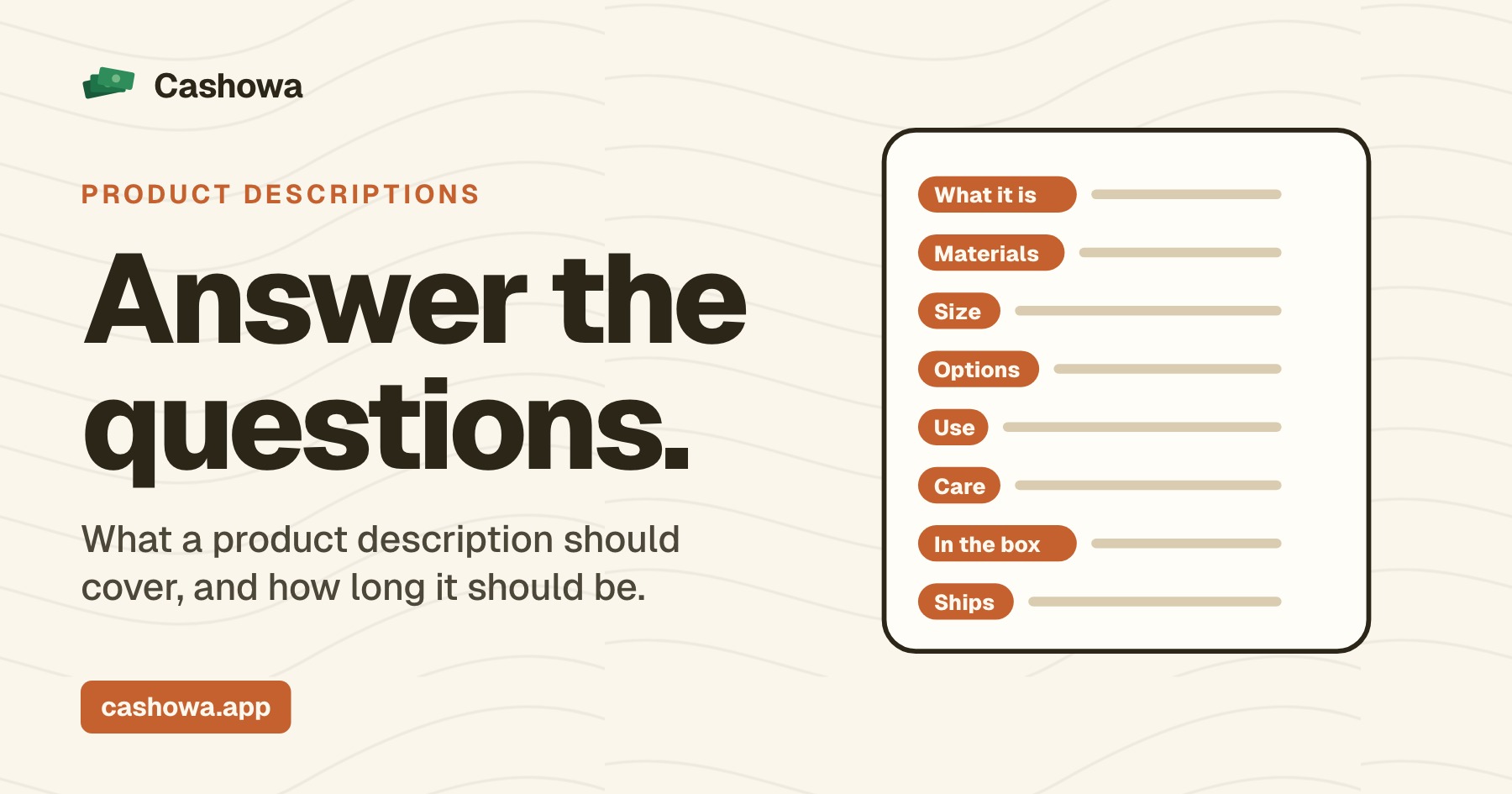
A product description is the part of a listing that answers what the photos cannot: how big the item is, what it is made of, how it is used and what arrives in the box. A buyer cannot pick the item up, so the description has to do it for them. This guide covers what a product description should include, how long it should be, what Etsy, Shopify and Google say about descriptions, and a template you can reuse for every listing. None of the platform pages we read says how much a description counts in its search, so the aim here is a description a buyer can use.
See what is holding your listings back
How Cashowa works for sellersWhat a product description is for
A listing's photos show the item and its title says what it is. The description is where a buyer finds the rest, the details that decide whether this is the one they want. A good one does three jobs. It answers the questions a buyer would otherwise have to message you about, it uses the words a buyer would search with, and it sets out what the buyer will receive, so that the item that arrives is the item they expected.
Etsy's help page on creating a listing asks you to describe the details of the item so buyers know what they are getting, and to include keywords buyers would use when searching for an item like yours, where you can.
What to cover in a product description
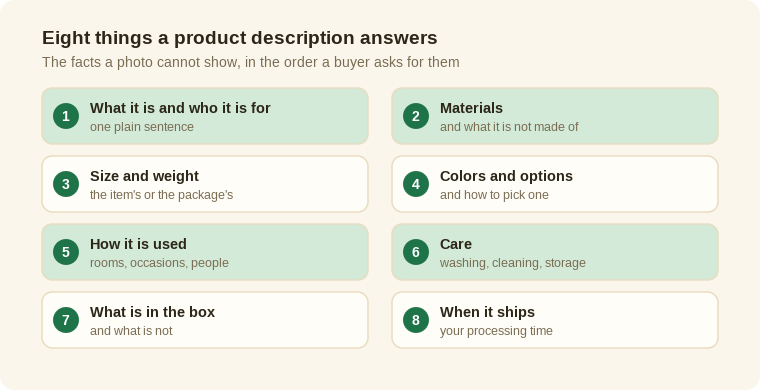
Cover these, in this order, in the words you would use to tell a friend about the item:
- What it is and who it is for. One plain sentence, using the name a buyer would search for.
- Materials. What it is made of, and what it is not made of if a buyer might assume otherwise.
- Size and weight. In inches and ounces for US buyers, and say whether the measurement is the item's or the package's.
- Colors and options. Every choice, and how the buyer picks one.
- How it is used. And the rooms, occasions or people it suits.
- Care. Washing, cleaning and storage.
- What is in the box. What is included, and what is not.
- When it ships. Your processing time, if the platform does not already show it.
Every line is a fact only you know. Write only the ones you can stand behind, because a buyer's decision rests on them.
How long should a product description be?
There is no single number, and the sources differ:
| Source | What it says about length |
|---|---|
| Etsy's help page on creating a listing | Gives no length for the description |
| Google Merchant Center, description attribute | 1 to 5,000 characters, with the most important details in the first 160 to 500 |
| Shopify's page on adding keywords | Suggests at least 250 words of descriptive text on a page you want found in search |
| Cashowa's health check | Flags a description under 80 words as thin, which is Cashowa's own rule of thumb and not a platform's |
Read those as guides. A plain white T-shirt needs fewer words than a camera lens, and padding a short description with filler only makes it harder to find the facts. The test is whether a buyer's questions are answered, and the first few lines matter most, because that is what a buyer sees before deciding to read on and what a search result tends to show.
Write in the words a buyer would use
Etsy's page says to include the keywords a buyer would search with. Shopify's page on adding keywords asks for readable, unique phrases that include some of your keywords, and says to avoid copying the text a manufacturer gives you. Google's Merchant Center page on the description attribute, which matters if your products appear in Google's shopping results, asks for a description that is specific and accurate, that describes only the product itself, and that has no links to other sites, all capitals or promotional text.
In practice that means three habits:
- Use both names a buyer might use. A mug is also a coffee cup and a tea cup, and a description can say so once, naturally.
- Say each thing once. A glossary entry on keyword stuffing explains why a list of repeated phrases helps no one, and a long-tail keyword such as "speckled stoneware mug" is a phrase to use in a sentence, not to repeat.
- Keep your own words. If you called it speckled, cream or heavy, those are the words a buyer will be looking for.
A template and an example
Write the description in five short blocks: a sentence about what it is, a list of details, how it is used and cared for, what is in the box, and shipping. Here is an invented example, a mug from an invented shop:
A 12 oz stoneware mug with a speckled cream glaze, made for coffee, tea or cocoa and for anyone who likes a heavy, solid cup in the hand.
Details: stoneware, glazed inside and out. Holds 12 fluid ounces, 3.5 inches tall and 3.25 inches across the top. Weighs 14 ounces. Cream with brown speckles; the pattern of each mug differs a little.
Use and care: microwave and dishwasher safe. Hand washing keeps the glaze shiny for longer.
In the box: one mug, wrapped in paper inside a box.
Shipping: ships 2 business days after the order.
It is about 110 words, every line is a fact the invented seller would know, and a buyer can find any one of them in a second.
Check it before you publish
- Every fact is true. Check each number against the item on your desk.
- It matches the photos. The colors, the material and the shape a buyer sees should be the ones you describe.
- It is yours. If you adapted a manufacturer's text, rewrite it in your own words.
- It reads well on a phone. Short paragraphs and a list for the details.
- Nothing is repeated from another listing, unless the item is the same.
What each platform gives you
| Platform | Where the description lives | Worth knowing |
|---|---|---|
| Etsy | The listing's Description field | Etsy asks for the details and for keywords buyers use |
| eBay | The Description, beside the item specifics | eBay's item description policy says required item specifics must be accurate and complete |
| Shopify | The product's description, with its own search engine listing fields | Shopify asks for unique text |
| WooCommerce | A long description and a short description | Which one a shopper sees where depends on your theme |
Our guides to writing product listings quickly and checking an AI-written listing cover the surrounding steps.
Where Cashowa fits
Cashowa's store health check lists every active listing with no description or with a thin one, under 80 words, so you can see where to start. Where the platform lets an app change a description (Etsy, Shopify and WooCommerce), Cashowa can draft one from what the listing already says and from any notes you type, as a suggestion. It keeps the words you wrote and does not add a detail you did not give it, you approve it before anything changes, it checks that the change landed, and you can undo it. On eBay, Cashowa writes titles and leaves descriptions to you. The glossary has an entry on the listing description, and how Cashowa works for sellers says what it reads and keeps.
Frequently asked questions
How long should a product description be?
It depends on the product. Etsy's page gives no length, Google's Merchant Center accepts up to 5,000 characters and asks for the most important details in the first 160 to 500, and Shopify suggests at least 250 words of descriptive text on a page you want found in search. Cashowa treats under 80 words as thin. Cover what a buyer needs and stop.
What should a product description include?
What the item is, its materials, size and weight, colors and options, how it is used and cared for, what is in the box and when it ships. Every fact should be one you know to be true.
Should I copy the manufacturer's description?
Shopify's page on adding keywords says to avoid directly copying text a manufacturer provides, and Google's page asks for a description of the product itself. Writing your own also lets you answer the questions your buyers actually ask.
Do keywords in the description help?
Etsy's page says to include keywords buyers would use, and Shopify's asks for phrases that include some of yours. None of the pages we read says how much a description counts in search, so write for the buyer first and use their words naturally.
The term 'Etsy' is a trademark of Etsy, Inc. This Application uses Etsy's API, but is not endorsed or certified by Etsy. eBay, Shopify and WooCommerce are trademarks of their respective owners. Cashowa is independent and is not endorsed or certified by any of them.