Business· Kamal F 7 min read
The Invoice Chasing Script — and What UK Law Lets You Charge
Most freelancers chase late invoices apologetically and never mention that interest may be theirs to charge. Here are the words to use, and the amounts you are entitled to add.
Invoice chasing is the part of freelancing nobody warns you about, and most people do it badly — not because they are bad at it, but because they are embarrassed. They open with an apology, ask if the invoice "might have been missed", and leave without a date.
There is a better approach, and it starts with a fact most freelancers do not know: whether you can add interest and fees to a late invoice has nothing to do with how awkward it feels. It depends on your terms and, in some countries, on the law. In the UK, interest on a late commercial invoice is yours by statute. In the US, it is yours if your invoice terms say so.
See which clients pay late, and what it is costing you
Track your cash flow freeWhat a late invoice can cost your client
In the US: your terms decide
There is no federal law giving private businesses automatic interest on a late commercial invoice. The Prompt Payment Act governs how quickly the federal government pays its suppliers, but it does not apply to private clients. For everyone else, late fees and interest come from your contract or your invoice terms.
That makes one sentence on your invoice worth real money. A frequently used version is a late fee of 1.5% a month. On a $5,000 invoice that is $75 a month, so $225 if it is three months late — but only if the clause was there before the invoice went out. Check your state's limits on interest before you pick a rate, and put the clause in your terms rather than inventing it at day 30.
In the UK: interest and compensation are automatic
Under the Late Payment of Commercial Debts (Interest) Act 1998, a business paying another business late owes two things on top of the invoice, and you do not need it written into the contract. These are UK rules, so the amounts below are in pounds; at about $1.32 to the pound, £100 is roughly $132.
Statutory interest at 8% plus the Bank of England base rate, running from the day payment became late. And fixed compensation per invoice, stepped by the size of the debt — £40 for debts under £1,000, £70 up to £9,999.99, and £100 for £10,000 and over.
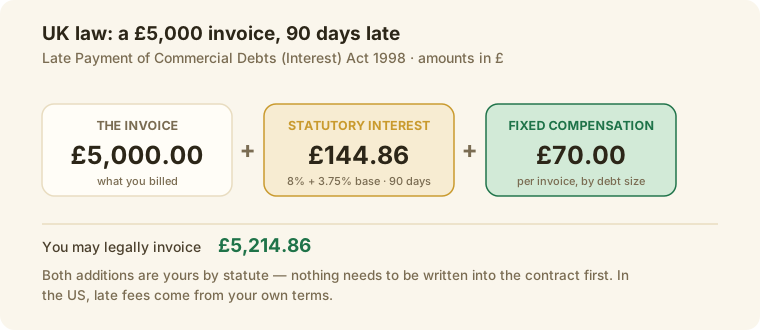
With the base rate at 3.75%, the statutory rate is 11.75%. On a £5,000 invoice paid 90 days late that is £144.86 of interest plus £70 of compensation — £214.86 on top of the invoice. The base rate moves, so check the current figures on gov.uk before you quote one — but the entitlement does not move.
Two things worth being clear about. This applies between businesses, not to consumers. And it is a right, not an automatic charge: you choose whether to invoke it, and most of the time the value is in being able to mention it rather than in collecting it.
The invoice chasing script
Four messages, escalating, with a date in every single one.
Day 1 after due date. Short, factual, no apology.
Hi [name] — invoice [number] for [amount] fell due yesterday. Could you confirm the payment date? Happy to re-send if it would help.
That is the whole message. No "sorry to chase", no "I know you're busy". You are not asking a favor; you are asking for a date.
Day 7. Introduce the terms without threatening.
Hi [name] — following up on invoice [number], now seven days past due. My terms include a late fee on overdue invoices, which I would rather not apply. Can you let me know when it is going out?
"Which I would rather not apply" does the work. You have stated the right and declined to use it, which is a considerably stronger position than not mentioning it. If your client is in the UK, say "statutory interest" instead of "a late fee".
Day 21. Go around the person, politely.
Hi [name] — invoice [number] is now three weeks overdue and I have not been able to get a payment date. Could you point me to whoever handles accounts payable directly? I would like to resolve this without escalating.
Very often the person who commissioned the work has no control over payment runs, and three weeks of silence means your invoice is stuck in a queue they cannot see. Asking for accounts payable is not aggressive; it is frequently the thing that fixes it.
Day 30. State what happens next, with a date.
Hi [name] — invoice [number] is now 30 days overdue. Under the late-payment terms on my invoice, a late fee of [amount] now applies, bringing the total to [total]. If payment is not received by [date], I will begin formal recovery. I would much rather settle this directly.
For a UK client, replace the late fee with: "I am applying statutory interest and compensation under the Late Payment of Commercial Debts Act from [date]."
Then do what you said on the date you said. A deadline you let slide teaches the client that the next one is also negotiable.
Why this works better than being nice
Late payment is rarely personal and almost never about your work. It is a queue, and queues are ordered by who follows up. A supplier who chases on day one with a specific question gets paid before a supplier who chases on day forty with an apology, every time.
Mentioning a late fee or statutory interest changes the queue position without changing the relationship, because you are citing terms or legislation rather than making a demand. Nobody takes offense at a clause they agreed to.
Stop the problem upstream
Chasing is damage control. Three things reduce how often you need it.
Invoice the day the work is done. If your terms are 30 days, invoicing on the 28th instead of the 1st brings the money forward four weeks and costs nothing.
Take deposits on anything substantial. Fifty percent up front halves your exposure and filters out the clients who were always going to be a problem.
Put the late-fee clause in your terms. In the US it is the only thing that gives you a claim at all. In the UK you have the right without it, but a client who has read it in your terms is more likely to pay on time.
And keep track of who pays late. A client who is consistently 60 days on 30-day terms is not a cash flow problem, they are a pricing problem — either their rate goes up to cover the cost of funding them, or they go. Most freelancers discover this pattern years later, because nobody is watching the gap between invoice date and payment date across all their clients at once. Our piece on why profitable businesses run out of money covers what that gap does.
Frequently asked questions
Can I charge interest on a late invoice?
In the UK, yes: under the Late Payment of Commercial Debts (Interest) Act 1998, statutory interest at 8% plus the Bank of England base rate applies to late business-to-business invoices, along with fixed compensation per invoice. In the US, only if your contract or invoice terms provide for it — there is no federal default for private clients.
How much compensation can I claim for a late invoice in the UK?
The fixed sum is stepped by debt size: £40 for debts under £1,000, £70 for debts from £1,000 to £9,999.99, and £100 for debts of £10,000 or more. It is per invoice, and it is in addition to the interest.
What should I say when chasing an unpaid invoice?
Ask for a payment date rather than apologizing for chasing. Keep it short and factual, mention your late fee or statutory interest from the second message onwards, and ask for accounts payable directly if the person who commissioned the work cannot give you a date.
Does statutory interest apply to consumers?
No. The Late Payment of Commercial Debts Act covers business-to-business transactions. Chasing a consumer is a different process and relies on your own contract terms.
When should I stop chasing and escalate?
Set a date in your final message and act on it. Thirty days overdue, with a stated deadline before formal recovery, is a reasonable point — and a deadline you let pass teaches the client that the next one is negotiable too.