Fees & profit· Kamal F 5 min read
What to Sell Online: Pick Your First Products by Margin, Not Hunch
A five-question test for choosing your first products, with three worked Etsy examples that show what each sale leaves you and what an hour of your time earns.
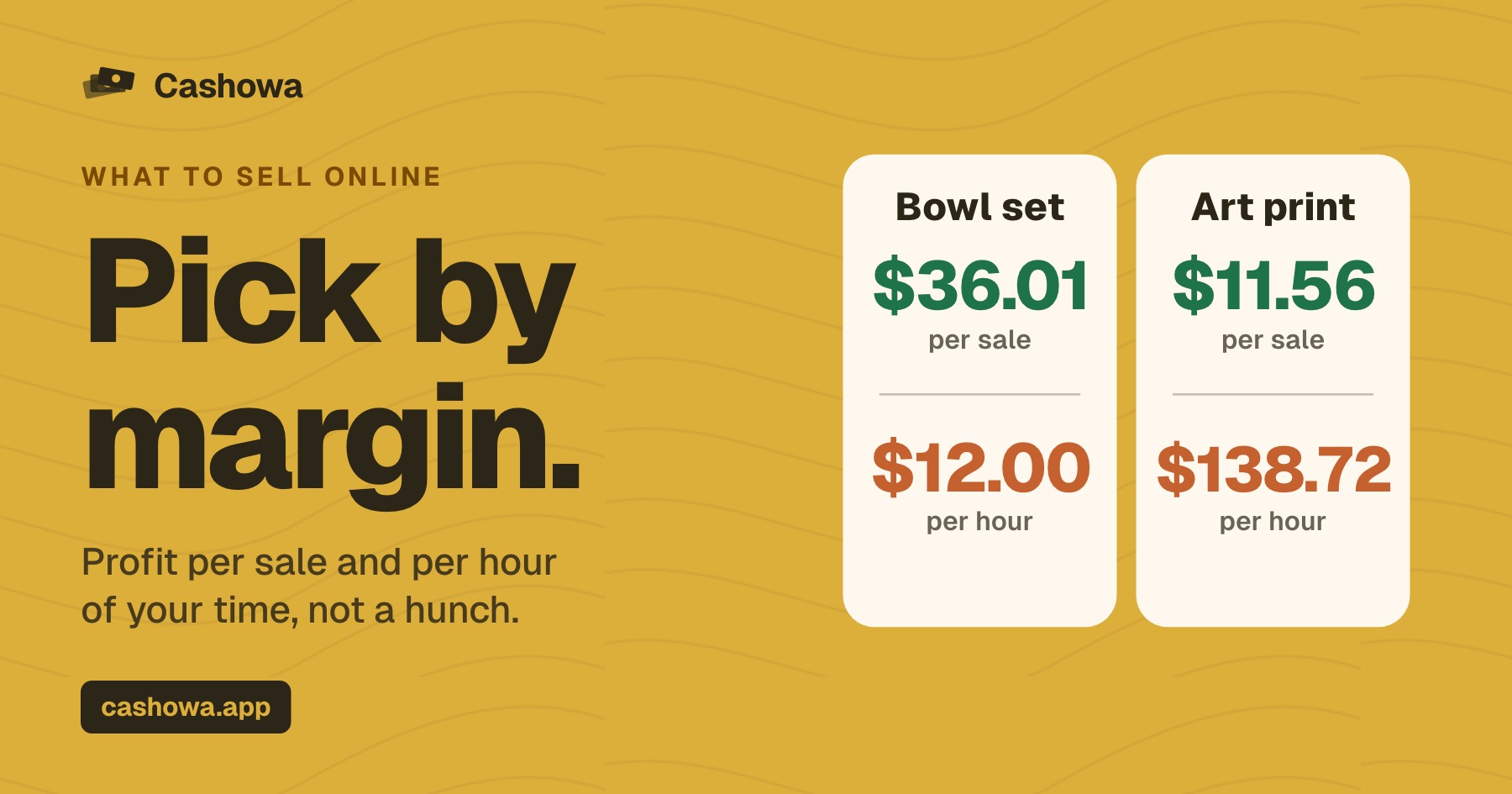
What to sell online is a question you can answer with arithmetic before you buy a single supply: what the item sells for, what the marketplace and the payment processor take, what the materials and packaging cost, what you pay to ship it, and how many minutes it takes you to make one. This guide gives a five-question test and works three invented Etsy examples through it. It does not say what is trending. The marketplaces do not publish demand figures for sellers to read here, and nothing in this guide forecasts sales.
Work out how many sales cover your costs
Try the break-even calculatorFive questions to answer before you decide what to sell online
- What does one cost you, packaged? Materials, the container or box, labels, and anything you add to the parcel.
- What do the fees take? Use the marketplace's own fee page, or the free Etsy fee calculator, which itemizes an order.
- What does it cost to ship? Weigh the packed item and price a real label, not a guess.
- What are buyers paying now for similar items? Look at several listings. Price is set by the buyer's alternatives, not by your costs.
- How many can you make or source in a week, and how long does each take? A product that leaves money only if you make a hundred a week may not fit your life.
Three worked examples
These are invented products with invented costs, so the point is the method. Etsy's fees come from Cashowa's fee engine (a US seller, no Offsite Ads, the buyer pays the shipping shown); the costs are the examples' own.
| Soy candle | Art print | Ceramic bowl set | |
|---|---|---|---|
| Item price, paid by the buyer | $24.00 | $18.00 | $64.00 |
| Shipping, paid by the buyer | $5.00 | $4.50 | $8.00 |
| Etsy fees | $3.21 | $2.59 | $7.29 |
| What is left after fees | $25.80 | $19.91 | $64.71 |
| Materials and packaging | $7.50 | $4.10 | $17.50 |
| Postage you pay | $5.60 | $4.25 | $11.20 |
| Profit on one sale | $12.70 | $11.56 | $36.01 |
| Share of what the buyer paid | 43.8% | 51.4% | 50.0% |
| Minutes of your time per item | 20 | 5 | 180 |
| Profit per hour of your time | $38.10 | $138.72 | $12.00 |
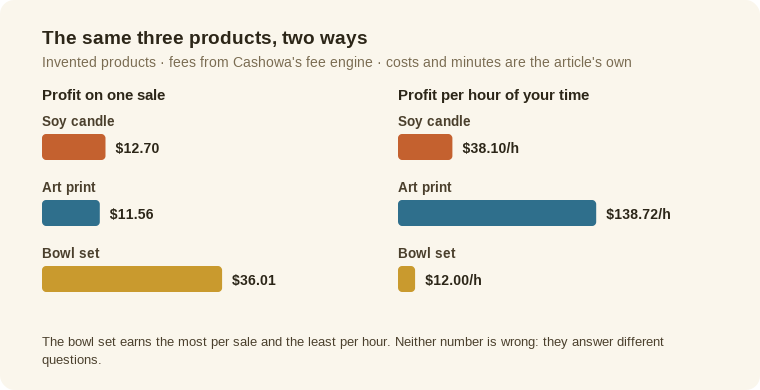
The three products leave a similar share of what the buyer paid, between 44% and 51%, which makes them look alike. The last line says otherwise: an hour spent on the print earns about eleven times what an hour on the bowls does. The bowl set earns the most per sale and the least per hour. Neither number is wrong. They answer different questions, and the right one depends on whether your limit is time, money or materials.
Two cautions. The print's five minutes leaves out the time to design it, which belongs in the cost of the first sale and spreads thinner with every later one. And a one-of-a-kind piece has no second sale to spread it over, so count the design in full.
Test before you stock up
Pick the two or three products that pass the test and list one of each. Photograph them well (our guide to product photography with your phone lists the shots a buyer needs), write the title and description from the facts you know, and see which one buyers choose over a month. Keep the unit costs written down as you go: they are the numbers you will need for pricing, for the break-even point and for taxes. Our guide to how to price a product goes further into setting the price.
What the table leaves out
The table counts fees, materials, packaging and postage, and then your time per item. It leaves out other costs of a real shop: the time you spend photographing, listing and answering buyers, any advertising you pay for, an occasional refund or a broken item, supplies you buy in bulk and do not use, and tax. Adding a line for each of these, even a rough one, makes the profit figure smaller and closer to the truth. Our guide to how to price a product starts from what you need to keep and works back to the price, which is the same arithmetic from the other end.
What would change the answer
A cheaper way to ship the item, a bulk price on materials, a higher price that buyers still accept, or a batch size that cuts your minutes per item. Change one and recompute, rather than changing everything and wondering which did it. If an item only works with a tiny change in one cost, it is fragile.
Where Cashowa fits
Cashowa does not tell you what to sell and has no demand or trend data. Two free tools do the sums in this guide: the Etsy fee calculator itemizes an order, and the break-even calculator turns your costs into a number of sales. After you have sales, the Products & orders page has a table where you enter what each item costs you, so your sales show up as profit rather than only revenue. What Cashowa can do shows the screens.
Frequently asked questions
What sells best online?
Nobody outside a marketplace can tell you that for your products, and this guide does not claim to. The test above shows which of the products you are considering leave money after fees, costs and your time.
How do I know if a product is profitable?
Subtract the marketplace fees, your materials and packaging, and the postage you pay from what the buyer paid. What is left is your profit on one sale, before your own time and before tax.
Should I count my own time?
Yes, at least as a check. Dividing profit per sale by the hours it took gives profit per hour, as in the table, and shows whether a product that looks profitable is only profitable because your time is free.
How many products should I start with?
Enough to learn from and few enough to do well. Two or three, each tested with one listing, is a common starting point, and you can add products once you know which costs behave as you expected.
The term 'Etsy' is a trademark of Etsy, Inc. This Application uses Etsy's API, but is not endorsed or certified by Etsy.