Platform guides· Jane Wilson 5 min read
Top 10 Online Selling Platforms in the US: Where Sellers Sell and How to Choose
Eight marketplaces ranked by size and two own-store platforms, with what each suits, the figures behind the ranking and how to choose where to start.
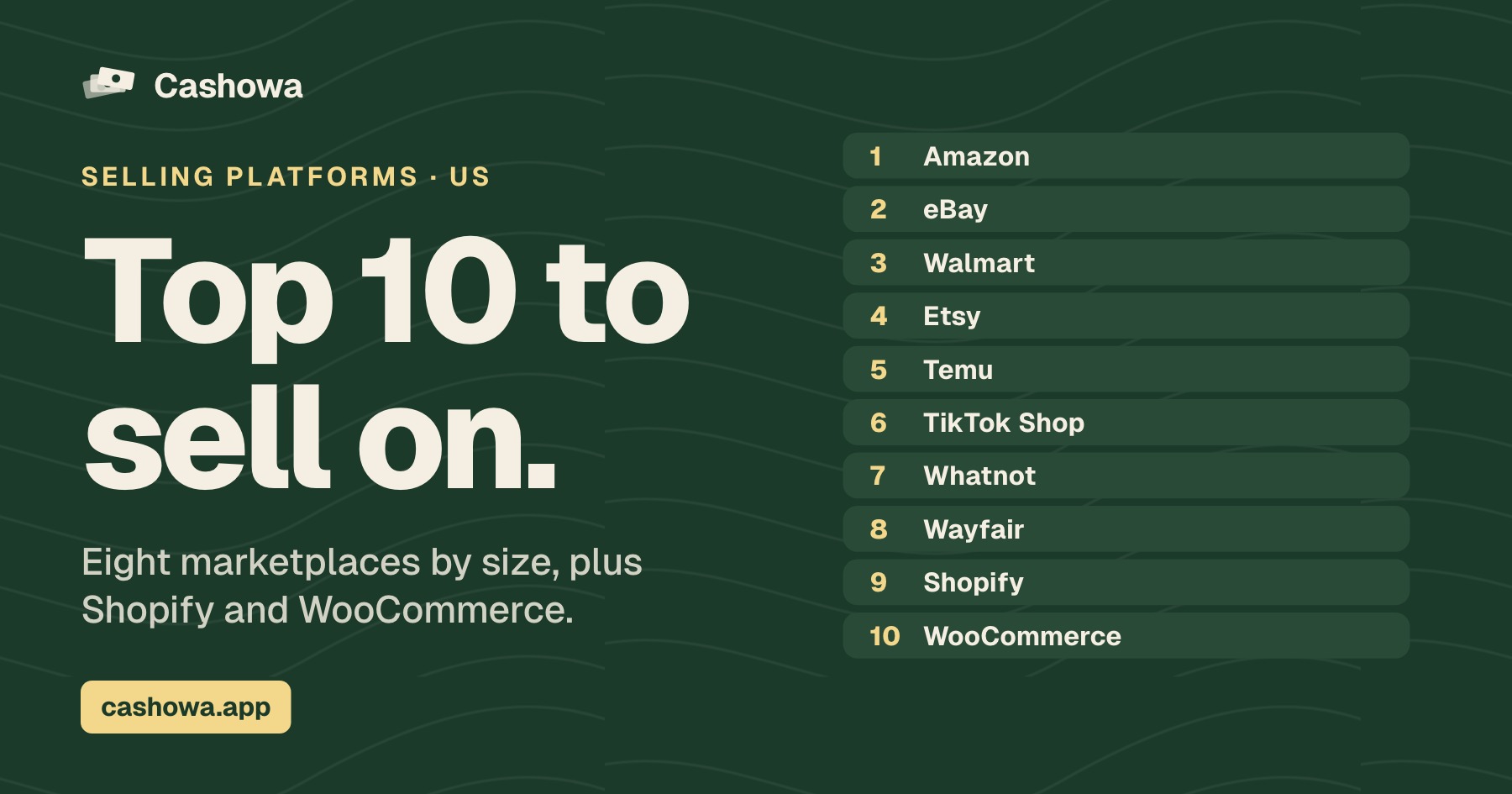
There is no official ranking of online selling platforms, so any top ten has to say what it measures. This one uses Marketplace Pulse's estimates of US marketplace sales, published on March 19, 2026, for eight marketplaces, and adds the two platforms people most often use to run their own store, Shopify and WooCommerce, in a group of their own because they are not marketplaces. For each it says what the platform suits, and it ends with how to choose where to start. The sales figures are estimates, and sources disagree with one another, so read them as a sense of scale and not as a measurement.
Work out what each platform leaves you
Try the Etsy fee calculatorHow the ranking of online selling platforms works, and what it cannot tell you
Marketplace Pulse's top 10 e-commerce marketplaces in 2026 estimates third-party sales for Amazon and gross merchandise value for the others, in the United States. It calls Amazon's figure and Temu's estimates, and it says Temu's does not fit a clean category because part of its business is consignment and part is semi-managed sellers. Another ranking, ECDB's, put eBay at $29.6 billion for 2024, against Marketplace Pulse's $39 billion, so two sources measuring different years and different things already disagree by a quarter.
Sales size is also not the same as how good a place it is for you to sell. A large marketplace has more buyers and more sellers competing for them, and the right place depends on what you sell, what you can afford in fees and how much of the customer relationship you want to keep.
The ten, in order
| # | Platform | Marketplace Pulse's US estimate | What it suits |
|---|---|---|---|
| 1 | Amazon | about $300 billion (third-party sales) | Standard branded goods, and sellers who can handle fulfillment at scale |
| 2 | eBay | $39 billion | Used, vintage and collectible items as well as new ones, with auctions and fixed prices |
| 3 | Walmart Marketplace | $15 billion (tied with TikTok Shop) | Standard goods; its marketplace passed 200,000 sellers |
| 4 | Etsy | $6 billion | Things made, designed, handpicked or sourced by you, and vintage at least 20 years old |
| 5 | Temu | $22 billion | Low-price goods; it is recruiting sellers with sign-up incentives |
| 6 | TikTok Shop | $15 billion | Selling through short video and creators |
| 7 | Whatnot | $6 billion | Selling live |
| 8 | Wayfair | $10 billion | Home goods, mostly bought from suppliers |
| 9 | Shopify | Not a marketplace | Your own store on a hosted platform |
| 10 | WooCommerce | Not a marketplace | Your own store on WordPress, which you host |
The table lists the marketplaces in the order that suits a seller, with their estimates beside them. By size alone Marketplace Pulse's order is Amazon, eBay, Temu, then TikTok Shop and Walmart tied, then Wayfair, then SHEIN, Etsy and Whatnot tied, then Target Plus. SHEIN and Target Plus are left out of the table because they are not open to any seller who applies. Marketplace Pulse leaves Shopify off its list because it is neither a marketplace nor a retailer, and says Shopify now claims 14% of US e-commerce, which it calls the decentralized alternative: sellers keep control of the storefront, the customer and the brand.
What each costs, from its own pages
Fees change, so each platform's own page is the source. For the four Cashowa connects to, our guide to what an online store really costs compares them on one $35 order from their own pages: Etsy charges a listing fee, a transaction fee and a processing fee, eBay a final value fee and a per-order fee, Shopify a monthly plan, and WooCommerce nothing for the software but a host and a payment processor. For Amazon, Walmart, Temu, TikTok Shop, Whatnot and Wayfair, read the seller pages before you apply. The numbers an article quotes are the ones most likely to be out of date.
How to choose where to start
- Start from what you sell. Handmade and vintage points to Etsy, used and collectible to eBay, branded goods you can ship in volume to Amazon or Walmart.
- Work out what one sale leaves you. Run a real product through the fee calculator and your costs before you list.
- Decide how much of the customer you want to keep. On a marketplace the shopper is the marketplace's. On your own store, they are yours, and so is the work of finding them.
- Start with one place. Learn its rules, and then add another. Our guide to Etsy, Shopify, WooCommerce and eBay side by side helps with the choice, and the guide to selling on more than one marketplace with what comes next.
- Keep your listings in a state you could copy. Clear titles, descriptions and photos move between platforms. Our guide to copying a listing between stores shows how.
Where Cashowa fits
Cashowa connects to four of these ten: Etsy, eBay, Shopify and WooCommerce. For those it checks every active listing for what is holding it back, drafts fixes for you to approve, checks that each landed, and lets you undo it. With New listings it can write a listing from your photos and notes, and copy a listing from one of those stores to another. It does not connect to Amazon, Walmart, Temu, TikTok Shop, Whatnot or Wayfair. How Cashowa works for sellers says what it reads and keeps.
Frequently asked questions
What is the biggest online marketplace in the US?
Amazon, by a wide margin. Marketplace Pulse estimates about $300 billion in third-party sales, many times eBay's $39 billion.
Is Etsy in the top ten?
Marketplace Pulse estimates Etsy's US sales at $6 billion, which puts it level with SHEIN and Whatnot and behind Amazon, eBay, Temu, TikTok Shop, Walmart and Wayfair. It is one of the main places to sell things made, designed, handpicked or sourced by you.
Is Shopify a marketplace?
No. Marketplace Pulse leaves it off its list because it is neither a marketplace nor a retailer. Shopify hosts your own store, and the shoppers are yours to find.
Which platform is best for a beginner?
The one that fits what you sell and the fees you can carry. Most new sellers start on a single marketplace, learn how a sale and its fees work, and add a second place later.
The term 'Etsy' is a trademark of Etsy, Inc. This Application uses Etsy's API, but is not endorsed or certified by Etsy. eBay, Amazon, Shopify and WooCommerce are trademarks of their respective owners. Cashowa is independent and is not endorsed or certified by any of them.