Business· Thomas Cuccittini 5 min read
Is ChatGPT Recommending Your Competitor? How to Find Out
Your customers are asking an assistant for recommendations, and it is already naming someone in your category. There is no referrer for a recommendation that did not happen.
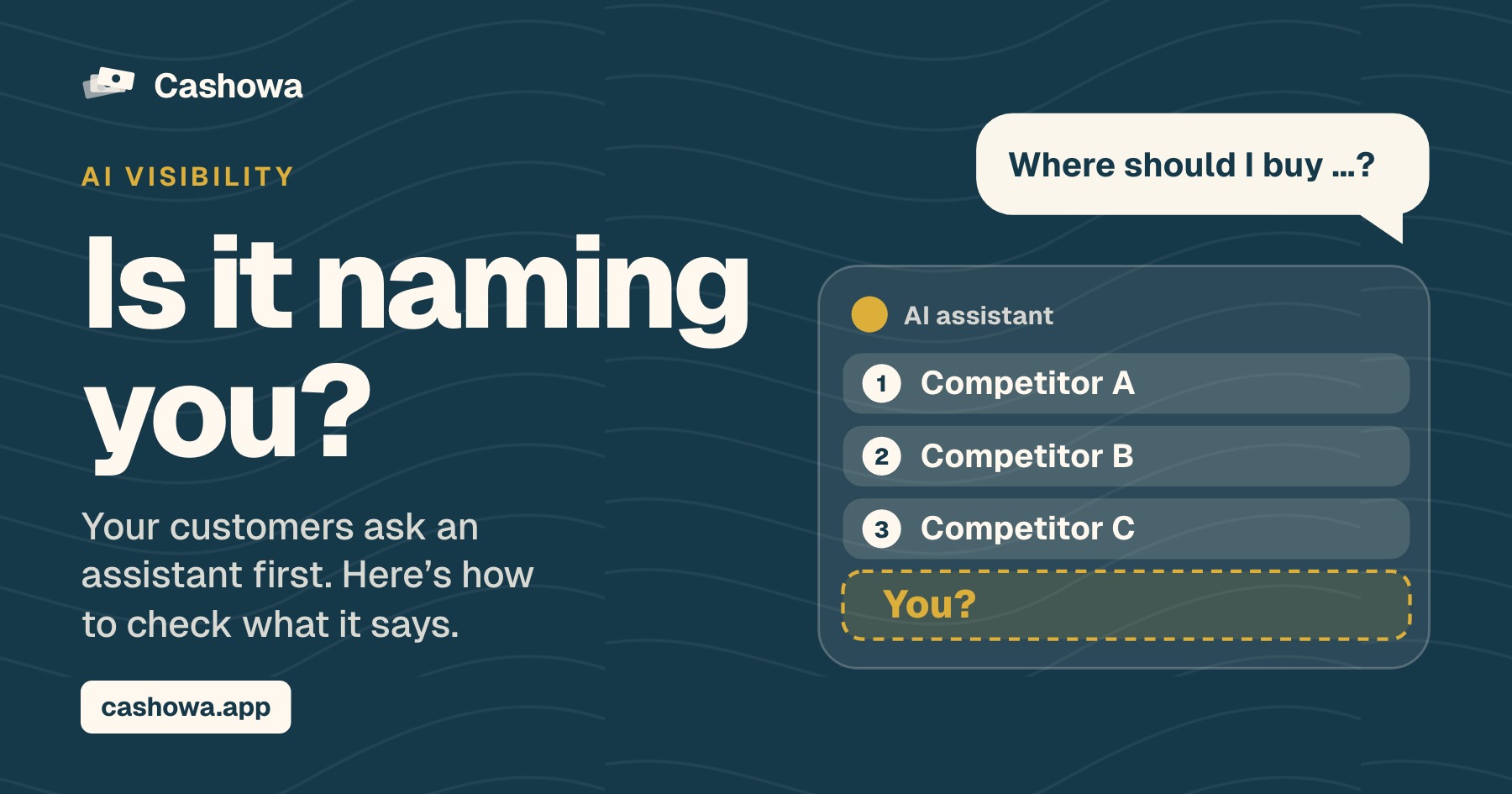
Is ChatGPT recommending your competitor? It is a reasonable question to be nervous about, because the honest answer for most small businesses is that they have no idea — and unlike every other channel they have ever marketed on, there is no report that will tell them.
When somebody finds you through Google, you see it in your analytics. When somebody asks an assistant for "the best supplier of X" and it names three companies that are not you, nothing happens. No impression, no referrer, no line in any dashboard. The sale simply goes somewhere else, invisibly.
Find out whether you get named — and who gets named instead
Run an AI visibility checkThis is not a future problem
The behavior has already shifted. People who would have typed a query and scanned a page of results now ask a question and act on the answer. And an assistant answering "who should I buy this from?" does not return ten blue links — it names two or three companies, usually the same two or three every time.
That is a far harsher distribution than search. Page one of Google has ten positions and people scroll. An AI recommendation has three slots and nobody asks for more. Being the fourth-best-known supplier in your category used to mean a trickle of traffic. Now it increasingly means nothing at all.
Is ChatGPT recommending your competitor? Check it in twenty minutes
You do not need a tool to start. You need to stop asking the question you want the answer to and ask the question your customer would ask.
Write down five real buying questions. Not "is my company good" — nobody types that. Write what somebody who has never heard of you would type when they have your problem and a budget. "Best wholesale silk flowers for wedding planners." "Where to buy bulk artificial greenery for event styling." "Cheapest place to buy faux florals in bulk."
Ask them in a clean session. Log out, or use a private window. If the assistant has your chat history it may well name you because you talked about you, which tells you nothing.
Record three things for each question: were you named, who was named instead, and which sources the answer cited.
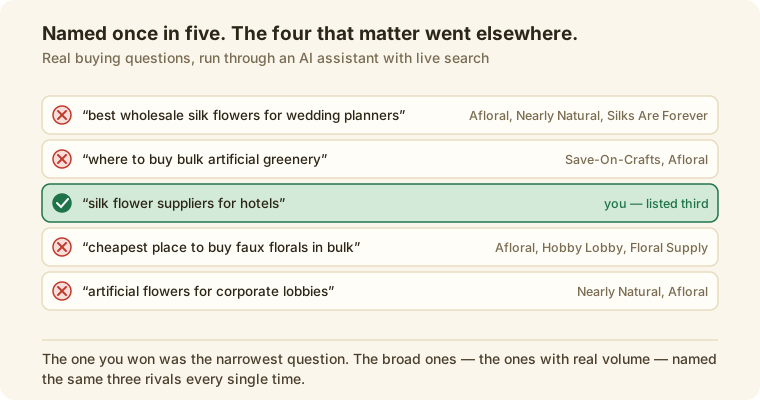
A typical result for a small business looks like the picture above: named once, in the narrowest question, and absent from the four with real volume.
The third column is the valuable one
Most people stop at "was I mentioned", which is the least useful of the three answers. The sources are where the work is.
Assistants with live search do not invent their recommendations — they read pages and summarize them. So when an answer names three competitors and cites a roundup article, a Reddit thread and a trade directory, it has just handed you a list of the specific places that decide who gets recommended in your category.
You cannot edit the assistant. You can get listed in the sources it reads.
That is a concrete, finite task list, and it looks nothing like a traditional SEO plan. A directory with modest traffic that happens to get cited by assistants is worth more to you than a high-authority page that never gets read by one.
What actually moves the needle
Be in the roundups. "Best X for Y" listicles are disproportionately cited because they match the shape of the question. Many accept submissions. Most small businesses have never asked.
Be describable. Assistants summarize. If your site never states plainly what you sell, who to, in what quantities, at what price, and where you ship, there is nothing to summarize and you will lose to a competitor whose page says all five.
Get third-party mentions, not just links. A sentence about you on a page someone else wrote carries more weight in a summary than a backlink, because the summary is built from sentences.
Check again in a month. The answers move. A single snapshot tells you where you stand; two tell you which direction you are going.
The honest caveat
Nobody outside the labs knows exactly how these recommendations are assembled, and the mechanics change without notice. Anyone selling you guaranteed placement in an AI answer is selling you something they cannot deliver.
What you can do is measurable and unglamorous: find out whether you are named, find out who is, find out what got read, and go get read. That was true of search engines for twenty years and it is true here. The only genuinely new part is that the scoreboard is invisible unless you deliberately go and look at it.
Frequently asked questions
How do I find out if ChatGPT recommends my business?
Ask it five questions a customer would actually type — not questions about your company by name — in a logged-out or private session so your own history does not skew the answer. Record whether you were named, who was named instead, and which sources the answer cited.
Why does ChatGPT recommend my competitors and not me?
Assistants with live search build recommendations from pages they can read. If your competitors appear in roundup articles, forum threads and directories that get cited, and you do not, they will be named and you will not — regardless of which business is better.
Can I pay to appear in AI assistant recommendations?
No, and anyone offering guaranteed placement cannot deliver it. What you can influence is the material the answers are built from: the roundups, directories and third-party pages that assistants cite when answering questions in your category.
Does SEO still matter if people use AI assistants?
Yes, but the target shifts. Ranking matters less than being described clearly on pages that get cited. A modest directory an assistant reads can be worth more than a high-authority page it never looks at.
How often should I check my AI visibility?
Monthly is enough for most businesses. A single check tells you where you stand; repeated checks tell you whether the work you are doing is changing anything, which is the only question worth answering.