Listings & SEO· Kamal F 6 min read
eBay Listing Title: How to Use All 80 Characters
An eBay title has 80 characters, and eBay's own pages say you have them to use. Here is what to put in, how to keep every keyword in the right order, and how item specifics share the work.
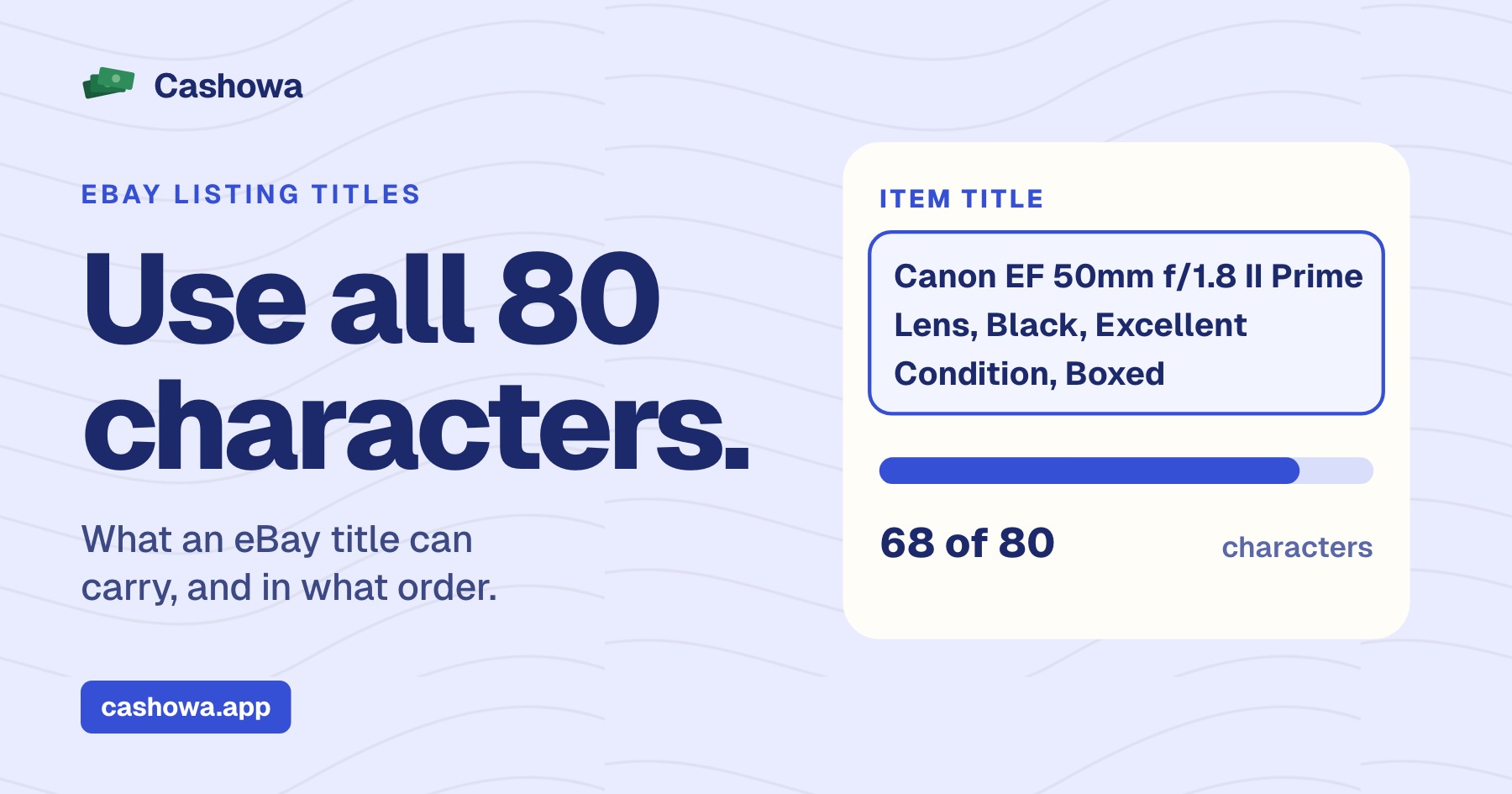
An eBay listing title is the one place you are given 80 characters to say what you are selling, and eBay's own pages say you have 80 characters to use. A title that stops at 40 has left half of them unused. This is what eBay says a title should hold, how to put every keyword in it in the right order, and how item specifics share the load.
See what is holding your listings back
How Cashowa works for sellersThe limit, and eBay's advice about it
A title can be up to 80 characters. eBay's Seller Center says you have 80 characters, and its help page on Best Match recommends a clear, concise title with correct spelling and no more than 80 characters.
The two fit together: clear and concise does not mean short. It means every word does something.
What to put in an eBay listing title
eBay's Seller Center says to include the brand, the model or type, the color, the style and the model number where there is one. In practice that comes to what it is, who made it, which model, the color and size, and the condition. Put the most important words first, because they are the first a buyer reads in a list of results.
Here is a before and after for a used camera lens, an invented example. A title with the words in the order they came to mind, 65 characters:
Lens Canon 50mm EF f/1.8 II Black Boxed Prime Excellent Condition
The same words in the order a buyer thinks of them, 68 characters:
Canon EF 50mm f/1.8 II Prime Lens, Black, Excellent Condition, Boxed
Every word is kept and none is said twice. The "/" in "f/1.8" stays because it is part of the lens's name. For a handmade item the same logic applies: what it is, what it is made from, the color and the size.
What to leave out
eBay's guidance is to avoid special characters and irrelevant words. eBay's own optimisation guide adds to avoid words in all capitals and markers such as asterisks between words. A character that is part of the real product name, such as the "/" in a lens's f-number, is fine.
Correct spelling matters because a buyer searches for the word as it is spelled. A misspelled brand is a listing nobody finds by the brand.
When you have more keywords than 80 characters hold
Put the most important words first and fit as many of the rest as you can. What does not fit has other places to go. eBay says to add item specifics such as make, model, size, color and style, and gives its reason: the more it knows about your item, the better it can match it to buyer searches. Item specifics are also what buyers use to filter a page of results, so a listing with them blank can be filtered out.
A sensible division of labor: put the words a buyer would type in the title, and the structured facts in item specifics. Do not leave a field blank to save time, and eBay advises not to enter "N/A" in a field that does not apply.
What eBay says goes into its ranking
eBay's Best Match page lists the factors it considers:
- how closely the listing matches the buyer's search terms
- how popular the item is
- the price
- the quality of the listing, including the description and the photos
- how complete the listing is
- the listing's terms, such as the return policy and handling time
- the seller's track record
eBay does not say how much each counts. The title is one of several ways a listing earns its match, and a good title on a thin listing does less than it could.
A short checklist
Read your title and ask:
- Does it say what the item is in the first few words?
- Does it carry the brand, model, color, size and condition that a buyer filters on?
- Is it using most of the 80 characters? A title of 40 leaves half unused.
- Does each word help a buyer find or choose the item? eBay's guidance is to avoid special characters and irrelevant words.
- Are the item specifics filled in for what the title does not say?
Where Cashowa fits
Cashowa connects to your eBay account through eBay's own sign-in, and checks your listings. On eBay it changes titles only: a title is a small change that is easy to take back, and a description on eBay is often a whole page of HTML that Cashowa does not rewrite. Its title check flags one that is missing, one under 50 characters, which leaves a good part of the 80 unused (a rule of thumb of its own, not eBay's), one over eBay's 80, and two listings with the same words. It can write a new title for you to approve, from your own listing, and it keeps every word and keyword you used: it may reorder them, join exact repeats and fix grammar, and it does not drop one. It checks the title against eBay's limit of 80 characters before asking eBay. eBay has no alt text on photos and gives no time of last change, so those two checks are left out for eBay instead of being counted as passed. Nothing changes until you approve it, and Cashowa checks afterward that the change landed. How it works for sellers says what it reads and keeps.
Frequently asked questions
How long can an eBay listing title be?
80 characters. eBay's Seller Center says you have 80 characters to use.
What should go in an eBay title?
What the item is, the brand, the model or type, the color, the style and the model number where there is one, with correct spelling. eBay's guidance is to avoid special characters and irrelevant words.
What if I have more keywords than fit in 80 characters?
Put the most important words first, and use item specifics for the structured facts. eBay says the more it knows about your item, the better it can match it to buyer searches.
Do item specifics matter if the title is good?
Yes. eBay says item specifics help match your item to buyer searches, and buyers filter results by item specifics. The title and the item specifics do different parts of the job.
Is the title the only thing that affects eBay search?
No. eBay's Best Match page lists how closely the listing matches the search, popularity, price, the quality and completeness of the listing, return policy and handling time, and the seller's track record. It does not publish how much each counts.
eBay is a trademark of its owner. Cashowa is independent and is not endorsed or certified by it.