Budgeting· Kamal F 5 min read
Why You Quit Expense Tracking After Two Weeks (It Isn't Discipline)
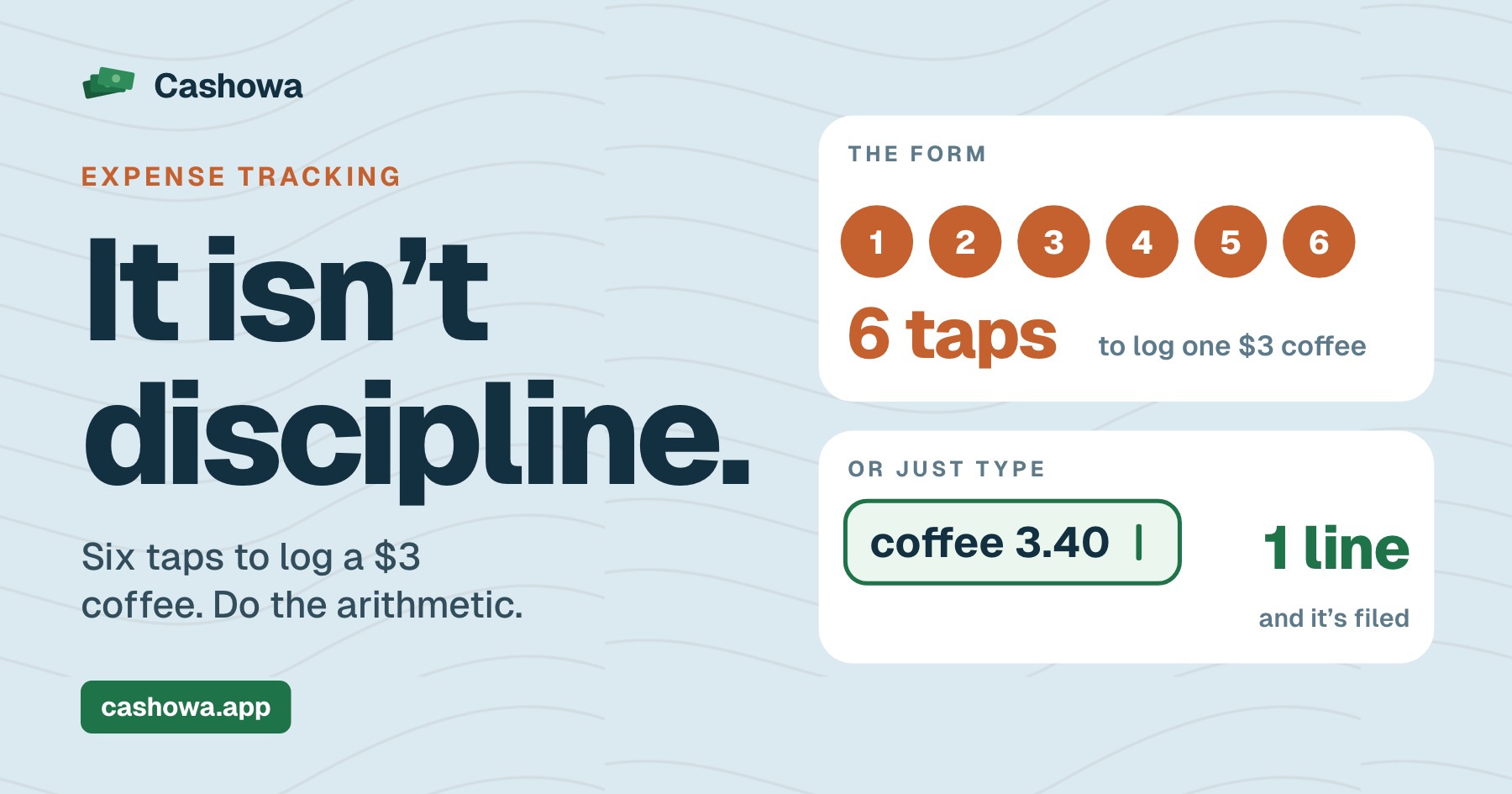
Nobody abandons expense tracking because they stopped caring about money. They abandon it because logging one coffee takes six taps. Here is the arithmetic.
Expense tracking has the highest intention-to-abandonment ratio of anything in personal finance. People do not start it casually — they start it because something worried them. And then, two weeks later, they stop.
The standard explanation is discipline, and the standard advice is to try harder. Both are wrong, and you can show it with arithmetic rather than psychology.
Photograph the receipt, or type one line. That is the whole step.
See how logging worksWhy expense tracking fails: do the friction maths
Logging one purchase in most finance apps means a form: amount, category, date, merchant, an optional note, then save. Six interactions, call it forty seconds including the moment of finding the app and remembering what the coffee cost.
Four purchases a day is not unusual. A coffee, a lunch, a bus fare, something from a corner shop.
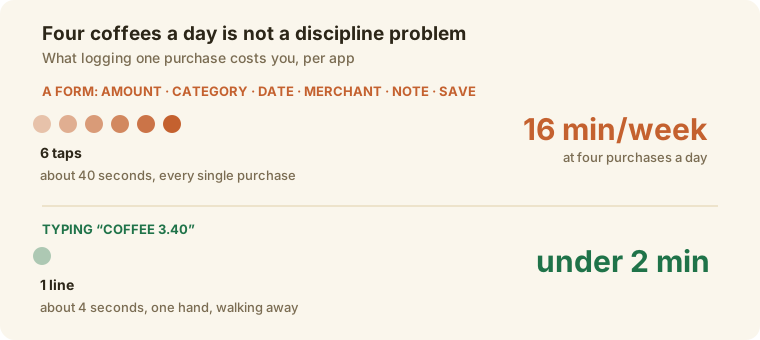
That is roughly sixteen minutes a week, spread across twenty-eight separate interruptions, each of which arrives at a moment when you are doing something else. Not sixteen minutes you sit down and spend — sixteen minutes extracted from you in forty-second pieces while you are walking out of a shop.
Nobody sustains that. Not because they lack willpower, but because the cost of the behavior exceeds the felt benefit of any single instance of it. You never regret skipping one coffee log. You regret it in aggregate, six weeks later, when the month is unreadable.
Why it fails in exactly two weeks
The pattern is consistent enough to be predictable, and it has three stages.
Week one: enthusiasm pays the cost. Novelty is doing the work. You log everything, including things you did not need to.
Week two: the first gap. A busy day, three unlogged purchases, and now there is a backlog. The backlog is the critical moment — it converts a forty-second task into a ten-minute one, and ten-minute tasks get postponed.
Week three: the records are wrong. Partial data is worse than no data, because it is misleading rather than absent. Your grocery total looks low. You know it is wrong. The app is now telling you something false, which removes the only reason you were using it.
The failure is not at week two. It is at the first gap, and everything after that is consequence.
Remove the cost, not the gap
If the problem is friction, willpower advice is treating the symptom. There are three ways to cut the cost of logging, and they work far better than resolve.
Photograph the receipt instead of reading it. The slow part is not the tapping, it is the transcription — reading a figure, remembering it, finding the field. A photograph moves that work off you entirely: merchant, total, date and category come off the image, and your job becomes a two-second check rather than a forty-second entry.
Type one line instead of filling a form. "coffee 3.40" contains everything a form asks for. A tool that parses it turns six fields into one line, one-handed, while you are still walking away from the counter. Under four seconds.
Accept that the statement catches the rest. This is the part people resist. You do not need to log every transaction live — your bank already did. Uploading a statement at month end fills in everything you missed, and live logging is only needed for the things a statement describes badly: cash, splits, and anything where the merchant name means nothing.
Together those take the sixteen minutes down to under two, and more importantly they remove the backlog mechanism. There is nothing to catch up on, so there is no first gap to fail at.
What to actually track
One more reason people quit: they track at a level of detail that serves nobody.
You do not need to know you spent $3.40 on coffee on a Tuesday. You need to know you spend about $65 a month on coffee, which is a different claim requiring far less precision. Categories should be as coarse as you can stand — six to ten, not forty — because the decisions you will make are coarse. Nobody has ever changed their behavior on the basis of a sub-category.
If you want somewhere to start, our guide to why your budget always fails by day 15 covers the other half of this problem: what to do with the numbers once you have them.
The honest test
Try this for one week: log nothing live, upload your statement at the end, and see how much of it you can explain. For most people it is 80–90% — the recurring bills, the supermarket, the obvious things.
That remaining 10% is the only part worth logging live, and it is a handful of transactions a week rather than twenty-eight. Which is a habit that survives contact with a busy Tuesday.
Frequently asked questions
Why do I always stop tracking my expenses?
Because the cost of logging exceeds the benefit of any single entry. Six taps per purchase at four purchases a day is around sixteen minutes a week in forty-second interruptions. The failure point is the first missed day, which converts a quick task into a backlog.
What is the easiest way to track expenses?
Reduce the work per entry rather than increasing your resolve. Photograph receipts instead of transcribing them, type a single line like "coffee 3.40" instead of filling a form, and let a monthly statement upload capture everything you did not log live.
Do I need to log every transaction?
No. Your bank already recorded them. Live logging is only genuinely useful for cash, split payments, and transactions whose merchant name tells you nothing. A statement upload fills in the rest.
How detailed should expense categories be?
Coarser than most people think — six to ten categories rather than forty. The decisions you make from the data are coarse, and fine-grained categories add work per entry without changing any outcome.
Is it better to track expenses daily or monthly?
Both, for different things. Monthly statement uploads give you complete data with no daily effort. A small amount of daily logging covers only what statements describe badly. Relying on daily logging alone is what creates the backlog that ends the habit.