How Cashowa works· Kamal F 4 min read
A 90-second financial onboarding
Most finance apps start with a 30-question form that nobody finishes properly. Cashowa replaces it with a conversation that takes 90 seconds and produces a more complete profile.
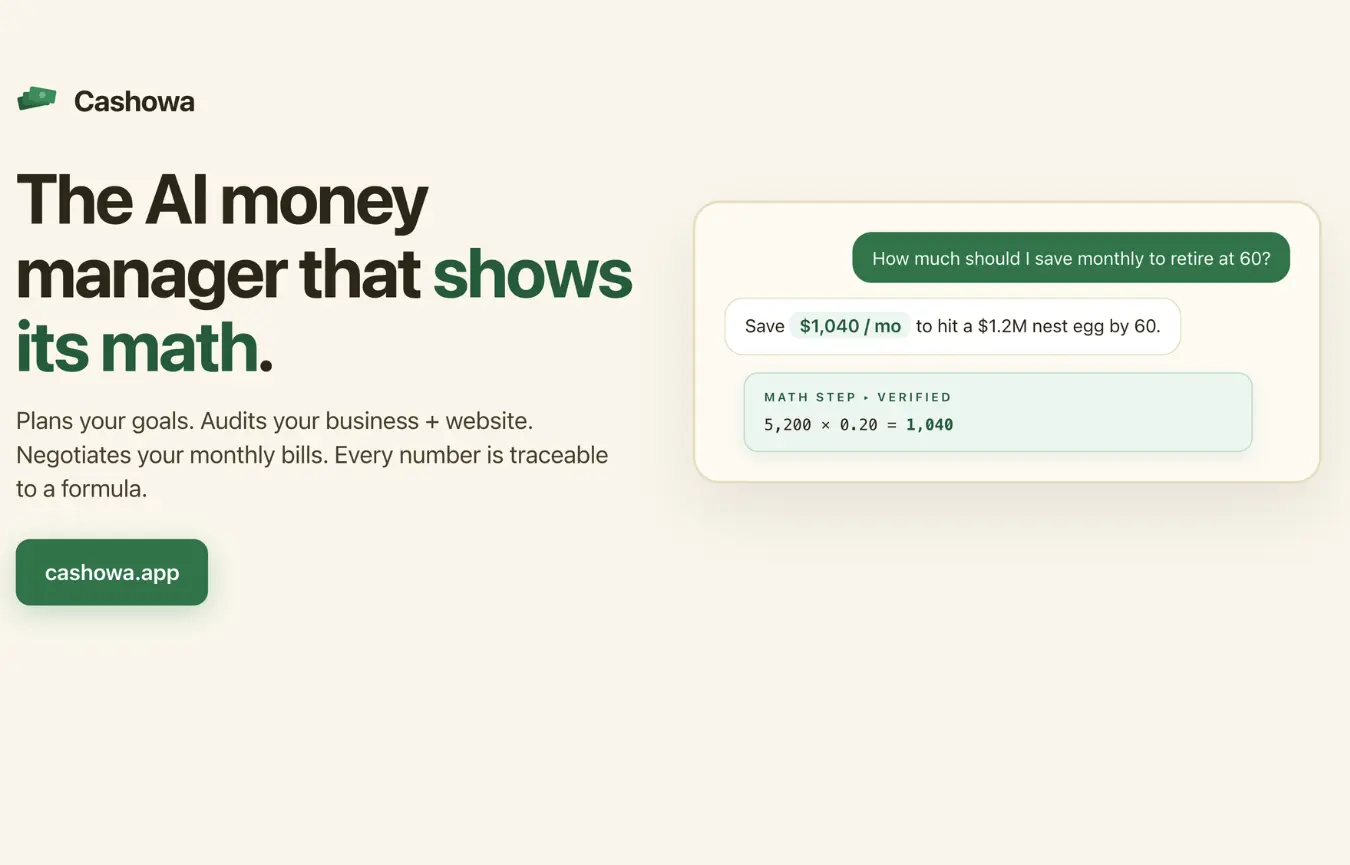
The standard way to onboard someone into a finance app looks like this:
[Age]
[Annual income]
[Monthly take-home]
[Monthly expenses: housing, food, transport, savings, ... 14 more categories]
[Goals: list up to 5]
[Risk tolerance: 1–10]
[Dependents: number]
[Debts: type / amount / APR / term — repeat for each]
[Assets: type / amount — repeat for each]
Even simplified, that's 30 fields. I built one. It works. People hate it.
What people actually do — and you can watch this in any session replay tool — is they fill in the first half thoughtfully, get bored around field 18, type "$5,000" into the income field, leave half the goals blank, and click "skip" on the rest. Then the app gives them a useless plan because the inputs are useless.
The form is asking the wrong question. It's not "what's your monthly take-home?" — it's "what do you actually want from this app?" And the answer to that isn't filling in 30 fields. It's a story.
What conversational onboarding actually looks like
In Cashowa, when you sign up, you don't see a form. You see a chat window with the agent saying something like:
Hey! I'd like to learn enough about your money to be useful. We can do this fast — tell me roughly how old you are, what you do for a living, and what's on your mind financially right now. I'll fill in the gaps with questions.
You type a few sentences. "I'm 32, I work in design, I'm trying to figure out if I can afford a house in five years."
The agent has a tool — save_financial_profile — that builds the same structured profile a form would produce. But it builds it incrementally, asking follow-ups only when the answer would change the plan:
- Did you say "32" but no income? It asks.
- Did you say "trying to buy a house" but no current savings? It asks.
- Did you say "I have student loans"? It asks for the APR and balance, because that genuinely matters to the plan.
- Did you skip the dependents question? It assumes zero and moves on. You can correct later.
The whole thing takes about 90 seconds in chat, versus the 5–8 minutes the form took. And the profile it produces is more complete on average, because people answer questions in conversation that they'd skip in a form.
What we kept
I want to be honest: this approach is not a clean win.
The form is deterministic. Every user, every time, hits the same fields. The conversation is probabilistic — sometimes the agent skips a useful question because the user's opening sentence answered it implicitly, sometimes it asks a question that's slightly redundant. There's variance, and variance is uncomfortable when the output is a financial plan.